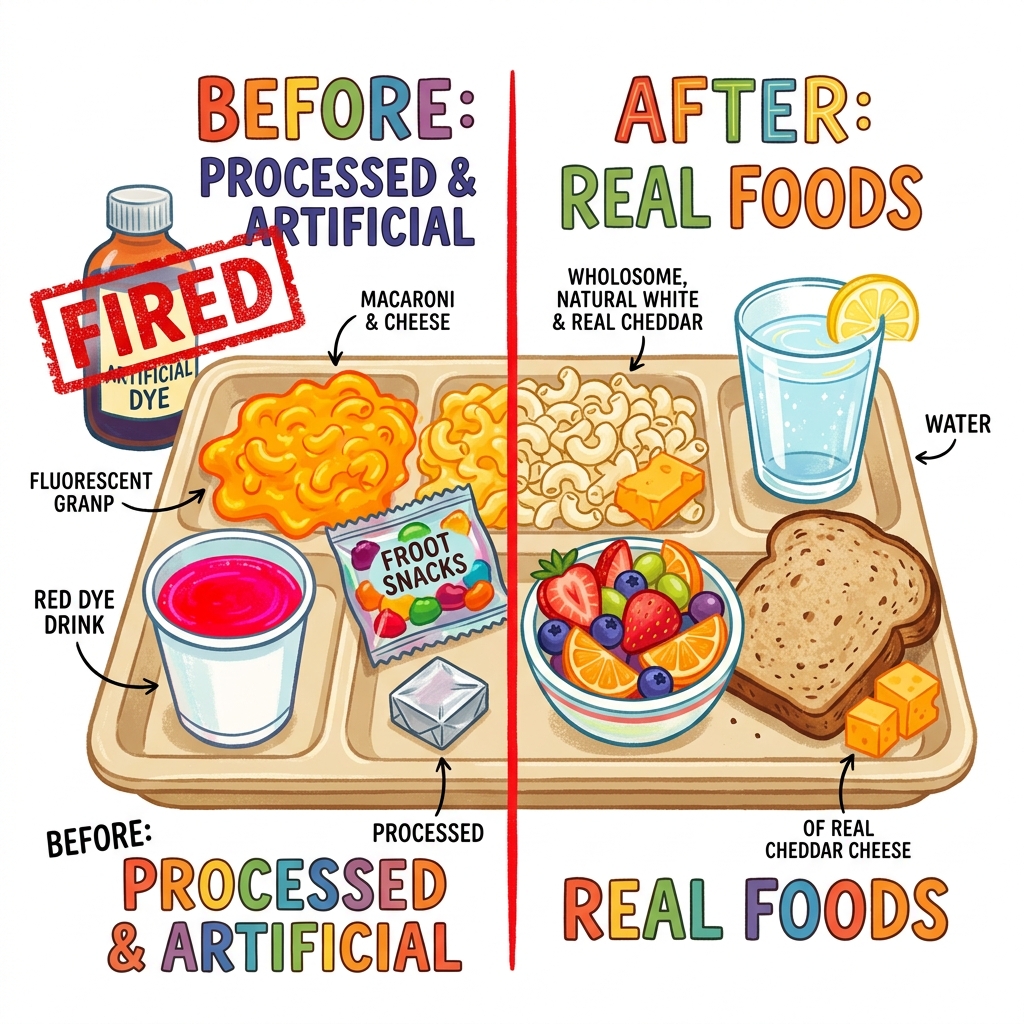
For years, parents have been packing lunches from home because they didn’t trust what the school cafeteria was serving. Fluorescent orange mac and cheese. “Fruit” snacks that contained zero fruit. Chocolate milk with more additives than a chemistry experiment.
That’s starting to change. And this time, it’s not just a petition on social media. It’s policy.
The Dominoes Are Falling
General Mills announced plans to remove artificial dyes from its U.S. cereals and from all foods served in K-12 schools by mid-2026 (NBC News, 2025). Not “we’re exploring options.” Not “we’re committed to long-term goals.” By mid-2026. That’s now.
California and West Virginia have banned artificial dyes in foods served in schools (NBC News, 2025). Utah banned synthetic dyes, potassium bromate, and propylparaben in public school food starting in the 2026-2027 school year (Just Food, 2025). Texas signed a bill requiring warning labels on foods containing ingredients banned in other countries — and while that’s not a school-specific ban, the pressure it creates flows directly into school food procurement (NBC News, 2025).
Why School Food Matters So Much
About 30 million children eat school lunch every day in the United States. For many of them — especially in lower-income households — that’s the most substantial meal they’ll get. When that meal is loaded with synthetic dyes linked to hyperactivity, preservatives linked to health risks, and sweeteners with questionable safety profiles, we’re not just feeding kids. We’re failing them.
The research connecting artificial food dyes to behavioral issues in children has been building for decades. The European Union requires warning labels on products containing certain dyes, stating they “may have an adverse effect on activity and attention in children.” The U.S. didn’t require that warning. Until now, it didn’t require much of anything.
What Parents Can Do Right Now
First, find out what your school district is serving. Many districts post menus online. Second, look at the ingredient lists — not the marketing. “Made with real cheese” can still contain artificial colors. Third, advocate. School boards respond to organized parents faster than almost any other constituency.
And arm yourself with information. Rock The New Food Pyramid’s tools aren’t just for grocery shopping. Use our barcode scanner on the packaged foods your kids bring home from school. Check the NOVA score. See what’s really in that “whole grain” pizza pocket. Your kids deserve better. And for the first time in a long time, better is actually on its way.
Stay informed. Eat real. Rock the New Food Pyramid.
#RockTheNewFoodPyramid #RTNFP SchoolLunch #KidsHealth #ArtificialDyes #FoodDyes #GeneralMills #SchoolFood #ChildNutrition #ParentingWin #CleanLabel #California #WestVirginia #Utah #Texas #FoodPolicy #EatReal #PackTheLunch
References
Just Food. (2025, December 16). A new recipe: US food groups act on additives. https://www.just-food.com/features/a-new-recipe-us-food-groups-act-on-additives/
NBC News. (2025, June 25). Nestlé says it will remove artificial dyes from U.S. foods by 2026. https://www.nbcnews.com/health/health-news/nestle-says-will-remove-artificial-dyes-us-foods-2026-rcna215107