
If you’ve been following food policy news, you’ve probably noticed something strange. The biggest names in American food manufacturing — Kraft Heinz, General Mills, Nestlé, Hershey, Smucker, Conagra, Tyson — have all announced they’re removing synthetic dyes from their products, on aggressive timelines, without being legally required to.
There is no federal law banning these dyes. The FDA’s much-publicized April 2025 phase-out plan is, in the agency’s own words, an “understanding” with industry. No fines. No enforcement mechanism. So why aren’t companies just ignoring it? The answer is the 30-state patchwork — and once you understand it, you understand why “voluntary” doesn’t mean what you might think.
What Is the Patchwork?
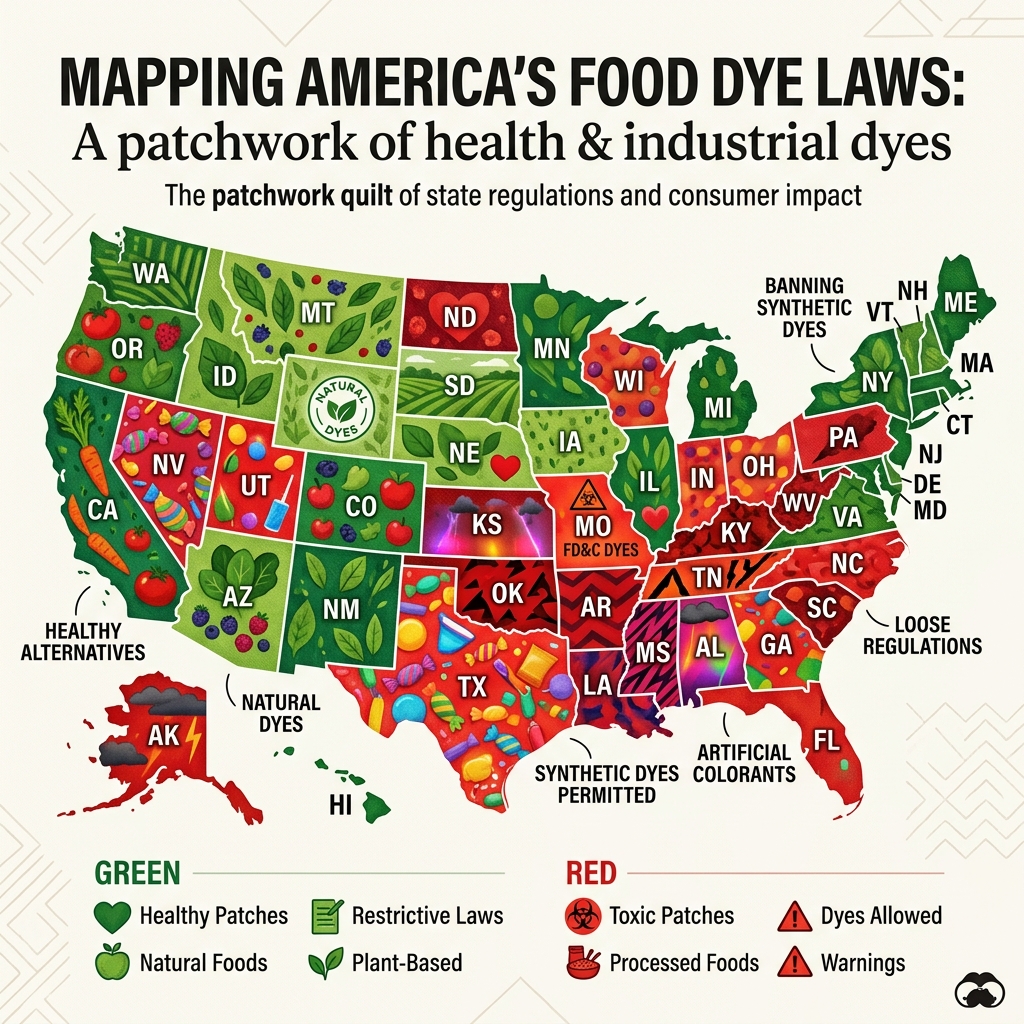
As of early 2026, roughly 30 states have either passed or formally proposed legislation targeting synthetic food dyes and related additives. That’s more than half the country. The bills vary widely:
- Some target only school meals (Utah, Arizona, Virginia, and others). —
- Some require warning labels rather than bans (Texas will require warning labels on foods with more than 40 additives starting in 2027). —
- Some go for full statewide retail bans (California on a narrower list, West Virginia on the broadest). —
More than 100 food additive-related bills were tracked during the 2025 legislative sessions alone, and they come from both sides of the political aisle. Deep-red West Virginia and deep-blue California passed laws within two years of each other. That bipartisan alignment is rare in 2026 — and it’s a huge part of why this is happening so fast.
Why Companies Are Caving Anyway
A national food brand cannot realistically maintain different formulas for different states. A box of Lucky Charms made in a single factory might be shipped to twelve different states. If three of those states ban Red 40, the manufacturer faces two options: build a parallel production line for those states (massively expensive), or just reformulate the entire national product line.
Reformulating once is cheaper than reformulating selectively. So that’s what they’re doing. Once you have ten or fifteen states with overlapping bans, the math flips and national reformulation becomes the cheaper path.
Add to this the European reality: most major American brands already produce dye-free versions for sale in the EU, where warning labels are mandatory. The recipes already exist. The factories already know how to make them. Companies have simply been keeping the cheaper, dye-laden versions on American shelves because, until recently, nothing forced them to change.
Who’s Made the Promise
Here’s the current scorecard of major manufacturers with public commitments:
Kraft Heinz — All artificial dyes out of U.S. products by end of 2027. About 10 percent of their portfolio is affected, including Crystal Light, Jell-O, and Kool-Aid.
General Mills — K-12 school foods and U.S. cereals dye-free by summer 2026; full retail portfolio by end of 2027.
Nestlé USA — Moving fastest of the multinationals: all FD&C synthetic dyes out by mid-2026.
Hershey — All U.S. confections (Jolly Ranchers, Twizzlers, Ice Breakers) dye-free by end of 2027.
Conagra, Tyson, WK Kellogg, Kellanova, J.M. Smucker, Utz, Walmart, and Save A Lot — All have pledged removal by December 31, 2027.
PepsiCo, Mondelez, McCormick — Working on dye-free reformulations, though stopping short of full removal pledges.
That’s essentially the spine of the American packaged-food industry.
The Big Asterisk
“Committed to” is not the same as “done.” Voluntary corporate pledges have a long history of slipping deadlines, quiet rollbacks, and creative loopholes. Most timelines stretch to the end of 2027 — a long time in food-industry years, and a lot can change. “Removal” doesn’t always mean what consumers think: some companies are removing only the most controversial dyes while continuing to use others, and some natural alternatives come with their own questions (carmine, for instance, is made from crushed insects).
The federal “understanding” has no teeth. The state laws have teeth, but they’re vulnerable to industry lawsuits — as we saw with the preliminary injunction blocking part of the West Virginia law in late 2025. None of this makes the pledges meaningless, but they shouldn’t be mistaken for a finished job.
What This Means for Your Family Right Now
The transition period is not a free pass. “My favorite brand will remove the dyes by 2027” is not a reason to keep buying the dye-laden version in 2026. The damage these ingredients do isn’t cumulative on a ten-year timer — it happens with every box, every bag, every drink.
The good news: you don’t need a law to make a better choice. You can read the label today. You can pick the version without Red 40 today. The 30-state patchwork is doing the slow work of changing the system, but you don’t have to wait for the system to change.
Get Ahead of the Patchwork with RTNFP
Knowing the trend is one thing. Knowing what to actually buy at the store this Saturday is another. That’s where Rock The New Food Pyramid comes in. We cut through the noise, decode the labels, and help families make better choices today — not in 2027 when the manufacturers finally get around to it. If this article was useful, come visit us for the practical tools and real-food know-how to feed your people well, right now.
Stay informed. Eat real. Rock The New Food Pyramid.
#RockTheNewFoodPyramid #RTNFP #DyeFree #CleanLabel #FoodFreedom
#MAHA #RealFood #ReadTheLabel #ToxinFreeKids #DyeWar
#FoodPolicy #HealthyKids #BigFood #ParentsAgainstDyes #ConsciousConsumer
Sources
- MultiState Insider, “States Move to Regulate Artificial Food Dyes and Additives” — Link
- Morgan Lewis Well Done, “State Legislation on Color Additives in Food: Takeaways for Industry” — Link
- The Food Institute, “The Latest in the War on Food Dyes” — Link
- Bakery and Snacks, “Synthetic Food Dye Ban: How Big Brands Are Reformulating in 2025” — Link
- Food Navigator USA, “General Mills and Kraft Heinz Plan to Remove Artificial Dyes from US Products by End of 2027” — Link
- Product Law Perspective, “Navigating Food Dye Regulation” — Link