
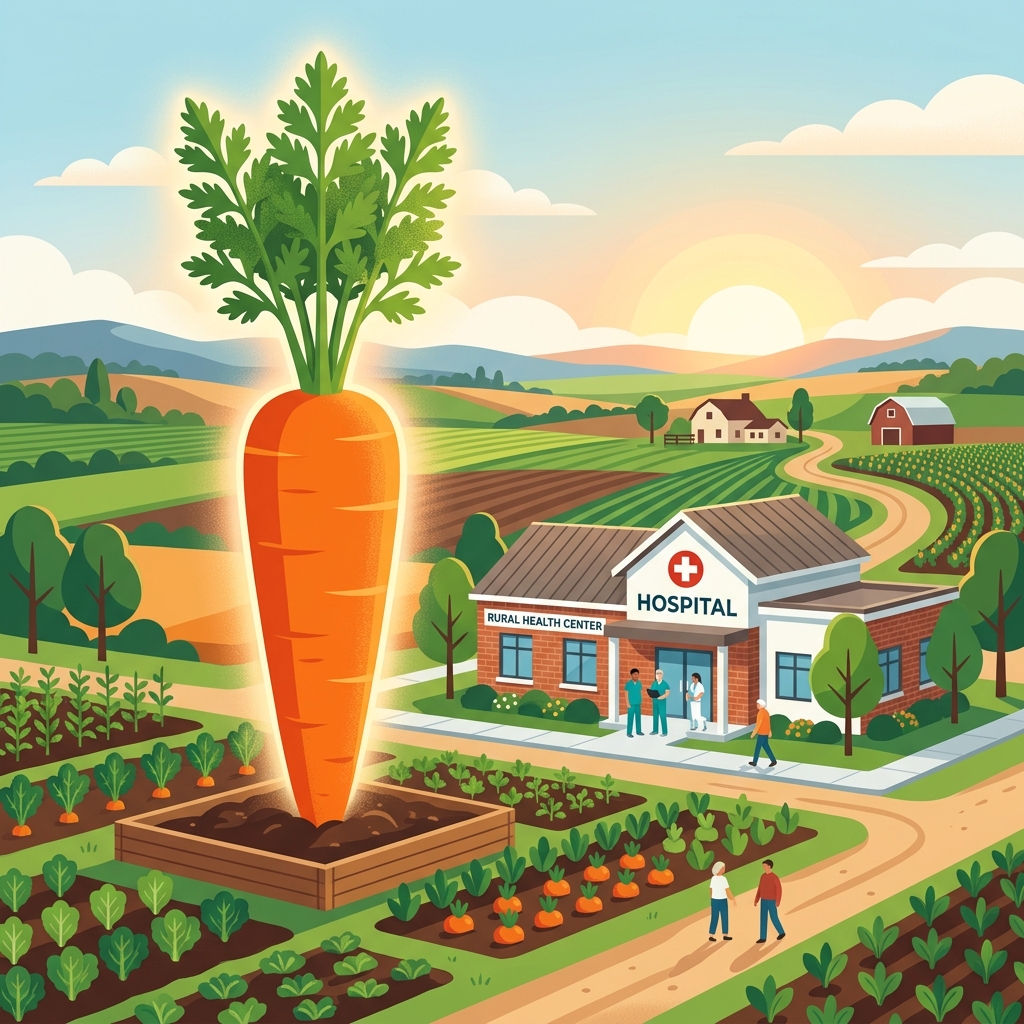
In December 2025, the federal government quietly opened the spigot on what may be the most consequential health-policy experiment in a generation. The Rural Health Transformation Program — a $50 billion fund created under the 2025 budget reconciliation law — began distributing money to states. And it came with strings attached.
The strings have a name: MAHA.
How the Money Works
The Rural Health Transformation Program will distribute $10 billion per year for five years, starting in fiscal 2026 and running through 2030. Half of that — $25 billion total — is split equally among all approved states. The other half is allocated based on a scoring framework that includes, among other factors, how aggressively a state has adopted MAHA-aligned policies.
First-year awards were announced on December 29, 2025. Every state received at least $100 million for fiscal 2026. The range went from about $147 million for New Jersey on the low end to $281 million for Texas on the high end — a substantial spread driven mostly by population, rural-resident metrics, and the strength of each state’s application.
Why This Is the MAHA Mechanism No One Is Talking About
The federal government can’t directly force states to adopt MAHA policies. That’s how American federalism works — states set most of their own health and food rules. But the federal government can offer money, and it can attach conditions to that money, and it can score grant applications based on whether the state is doing things the administration wants done.
That’s exactly what’s happening here. CMS Administrator Mehmet Oz has been publicly clear that states making bigger commitments to MAHA-aligned reforms — things like banning food dyes, restricting ultra-processed foods in schools, expanding access to whole foods in food deserts, and tackling chronic disease prevention — are getting larger awards. “Make Rural America Healthy Again” is one of the program’s five formal strategic goals.
In other words: the federal government is paying states to enact MAHA policies. Not requiring it. Just paying them. That’s a much harder thing to fight in court than a federal mandate, and it’s a much faster way to spread policy adoption.
The Carrot vs. the Stick
Federal policy traditionally offers two ways to influence state behavior: regulation (the stick) or funding (the carrot). The MAHA strategy has been notably stick-light. Few new federal mandates. The dye “phase-out” is voluntary. The corporate pledges are voluntary. State patchworks are doing most of the actual restricting.
But the carrot — $50 billion of it — is enormous. And it’s being pointed directly at the policy areas the administration cares about. States that want their share need to demonstrate that they’re moving in the right direction. Annual review cycles will determine 2027 funding levels. States that don’t deliver risk losing future installments.
This is, frankly, smart politics. It avoids the legal vulnerabilities of federal mandates. It moves faster than rulemaking. It creates state-level political ownership of the changes. And it gives every governor in the country a fiscal reason to align with MAHA priorities, regardless of which party they belong to.
What States Are Proposing
Based on publicly available state applications and the abstracts CMS has posted, states are pitching a wide variety of MAHA-flavored initiatives:
- Improved access to fresh and healthy foods in rural areas (food deserts, mobile markets, healthy corner store programs) —
- Chronic disease prevention and management programs —
- Telehealth expansion and remote patient monitoring —
- Rural workforce development and training pipelines —
- Programs targeting maternal and infant health — directly aligned with Operation Stork Speed
- Substance use disorder treatment and prevention —
Some of these are clearly MAHA-flavored. Others are general rural health priorities that any administration would support. The blending is intentional — states get to address local needs while also racking up MAHA scoring points.
The Critique
Not everyone is enthusiastic about this structure. Critics, including some health policy researchers and rural health advocates, point out a few legitimate concerns. The $50 billion is partially offsetting much larger cuts to Medicaid — about $911 billion in federal Medicaid reductions over ten years, including roughly $137 billion in rural areas. From that lens, the rural health fund is a partial Band-Aid on a much bigger wound.
Others note that the MAHA-policy scoring criteria could disadvantage states whose political leadership doesn’t want to align with the administration. And there are open questions about how the funds will actually flow to small rural hospitals versus larger administrative initiatives.
All of these are fair concerns. But the basic mechanism — federal money attached to MAHA-aligned policy adoption — is now operating at scale. The first $10 billion is in motion. That’s a real thing that’s really happening.
Why You Should Care
Even if you don’t live in a rural area, the rural health fund will affect what you see on grocery shelves and in school cafeterias over the next five years. Because the money is incentivizing states to adopt MAHA-aligned food policies, you’ll see more state-level action on dyes, additives, ultra-processed foods, and school nutrition. The federal carrot is going to multiply the state patchwork we’ve already been tracking. By 2030, the U.S. food landscape may look meaningfully different — and the funding mechanism that drove a lot of it will be this program.
Make Your Family’s Health Transformation Personal — with RTNFP
Federal programs take years to filter down to your kitchen counter. You don’t have to wait. Rock The New Food Pyramid is here for the parents, grandparents, and caregivers who want to start their own “health transformation program” today — with the practical guidance, label-reading skills, and real-food strategies that work in your actual life. Thanks for caring enough to read about food policy. It’s how change happens.
Stay informed. Eat real. Rock The New Food Pyramid.
#RockTheNewFoodPyramid #RTNFP #MAHA #RuralHealth #FoodPolicy
#PublicHealth #ChronicDisease #Prevention #RealFood #CleanLabel
#HealthReform #StatePolicy #ToxinFreeKids #HealthyCommunities
Sources
- CMS, “CMS Announces $50 Billion in Awards to Strengthen Rural Health in All 50 States” — Link
- CMS, “Rural Health Transformation (RHT) Program Overview” — Link
- STAT News, “Trump's $50 Billion Rural Health Fund Rewards States with MAHA Ideas” — Link
- CBS News, “States Race to Prove They'll Use Rural Health Funds Wisely” — Link
- KFF, “First-Year Rural Health Fund Awards Range From Less Than $100 Per Rural Resident in Ten States to More Than $500 in Eight” — Link