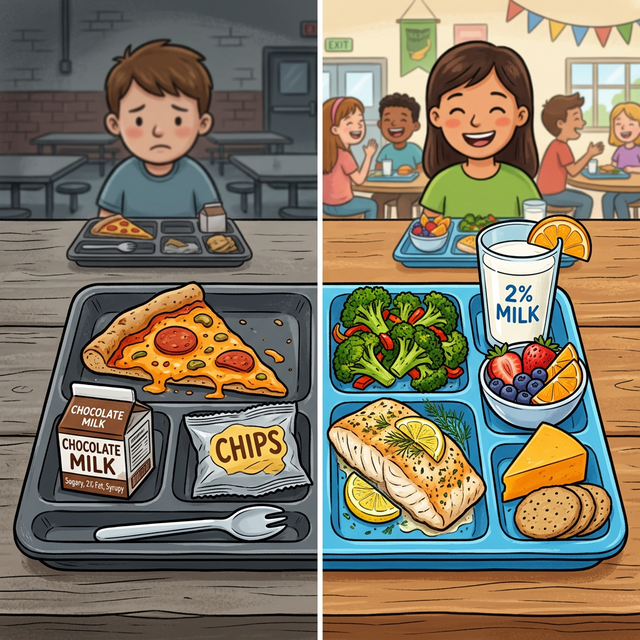
Look at the lunch tray of a child attending school in France or Japan: baked fish, fresh vegetables, real cheeses, and fruit. Now look at a standard American public school lunch tray: frozen pizza loaded with soy protein, chicken nuggets formed from pink slime, and chocolate milk packed with high-fructose corn syrup.
We are feeding our most vulnerable population the most highly processed, nutrient-void food available. And it's causing a crisis.
The Rise of UPFs in Schools
How did we get here? It comes down to budgets and lobbying. Fresh food requires kitchens, chefs, and prep time. It is infinitely cheaper for school districts to buy frozen, ultra-processed food (UPF) commodities that only need to be reheated in a microwave or oven by a minimal staff.
Furthermore, major food corporations actively lobby to ensure their highly processed products qualify for federal reimbursement programs. To meet outdated nutritional guidelines involving "grains" and "dairy," schools serve heavily sweetened yogurts and breakfasts consisting of sugary cereals—checking the bureaucratic boxes while flooding children with sugar and artificial dyes.
The Behavioral Toll
Teachers across the country report the same phenomenon: the after-lunch crash. Children return from the cafeteria vibrating with energy from artificial food dyes and sugar spikes, followed quickly by lethargy, irritability, and an inability to focus as their blood sugar crashes.
It's incredibly difficult to teach a child whose brain is starved of healthy fats (essential for cognitive development) and inflamed by emulsifiers and seed oils.
The Public Health Push for Cafeteria Reform
One of the most popular and bipartisan goals of the "Public Health" movement is the total overhaul of the school lunch program. The proposed reforms are sweeping:
- Banning foods containing artificial dyes (like Red 40) from school menus.
- Removing added sugars and high-fructose corn syrup from school breakfasts and milk.
- Incentivizing schools to install real kitchens to cook whole foods from scratch.
- Partnering with local farms to provide fresh meat and produce instead of relying on multinational packaged food suppliers.
Until these institutional changes happen, parents are left to bridge the gap. Packing a lunch focused on the New Food Pyramid—heavy on high-quality proteins and healthy fats, with whole fruits and avoiding packaged snacks—is one of the most powerful things you can do for your child's academic and physical success.
Pack a Lunch You Can Trust
We can't change the public school cafeteria system overnight, but we can completely control what goes into our children's lunchboxes today. The transition away from ultra-processed lunch items is easier than the food industry wants you to believe.
Equipped with the Rock The New Food Pyramid app, you can scan every snack, juice box, and sandwich bread before it ever enters your home. The app instantly flags the artificial dyes and emulsifiers that cause the afternoon crash, suggesting clean, NOVA-approved swaps that still taste great.
Take the cafeteria crisis into your own hands. Download the RTNFP app and start fueling your kids for success.
References & Citations
- University of São Paulo (USP) Center for Epidemiological Studies in Health and Nutrition. The NOVA Food Classification System.
- National Academies of Sciences, Engineering, and Medicine (NASEM). Toxicology and Safety Assessments of Food Additives.