
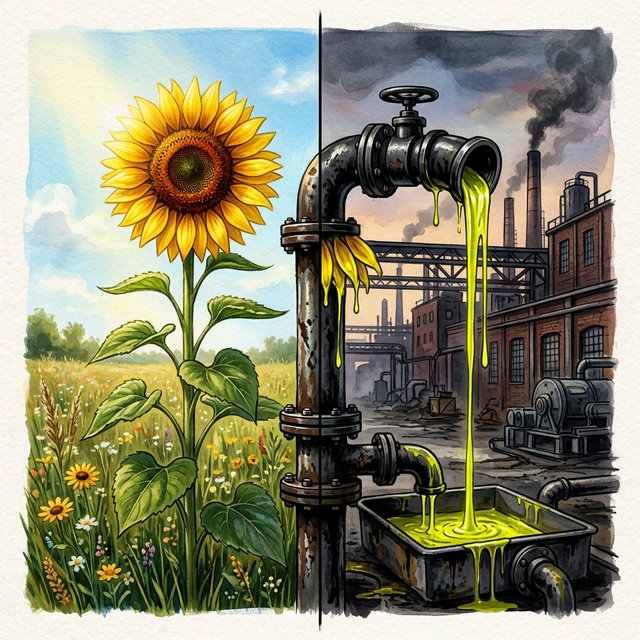
For the last thirty years, health authorities told us to replace our butter and lard with "heart-healthy" vegetable oils. Today, those same vegetable oils—more accurately known as industrial seed oils—have become one of the most polarizing topics in nutrition.
From the Harvard T.H. Chan School of Public Health to independent health influencers, there is a massive push to eliminate soybean, canola, corn, and sunflower oils from our diets. But are they really that bad? Let's look at the science.
What Are "Industrial" Seed Oils?
You can squeeze an olive or an avocado and get oil. You cannot simply squeeze a dried kernel of corn or a soybean and get oil. Getting oil out of these seeds requires an intense, multi-step industrial process.
Here is how the canola or soybean oil in your pantry is typically made:
- Heating: The seeds are crushed and heated to extreme temperatures.
- Hexane Extraction: The crushed seeds are bathed in a chemical solvent called hexane (a petroleum byproduct) to extract the remaining oils.
- Degumming & Bleaching: The oil is treated with acid to remove gums, then bleached with clay to remove its unnatural color.
- Deodorizing: Because the processing makes the oil smell terrible and rancid, it is heated to over 400°F (200°C) to chemically deodorize it before it is bottled.
While the FDA notes that only trace, safe amounts of hexane remain in the final product, critics argue that the sheer violence of this processing—specifically the high heat applied to unstable polyunsaturated fats—creates oxidized lipids and free radicals before the bottle even leaves the factory.
The Omega-6 Problem and Inflammation
Historically, humans consumed a roughly 1:1 ratio of Omega-6 fatty acids to Omega-3 fatty acids. Today, thanks to the sheer volume of seed oils pumped into processed foods and restaurant fryers, the modern American diet sits at a staggering ratio of roughly 20:1.
While Omega-6 fatty acids (like linoleic acid) are essential in small amounts, an extreme overabundance is linked to systemic, chronic inflammation. When heated repeatedly (like in a fast-food deep fryer), these oils break down into toxic compounds known to cause oxidative stress in the body.
The Shift Back to Traditional Fats
In the New Food Pyramid, highly processed industrial seed oils are classified as NOVA 4 (Ultra-Processed) or highly degraded NOVA 2 ingredients that should be limited.
The alternative? Look to the top of the New Food Pyramid: use stable, traditionally extracted fats like Extra Virgin Olive Oil, Avocado Oil, grass-fed butter, ghee, and coconut oil.
The hardest place to avoid seed oils is in packaged foods. Oat milk, salad dressings, and crackers are almost universally packed with canola or sunflower oil. Use the Rock the New Food Pyramid scanner to check the ingredient lists of your favorite snacks and find cleaner alternatives.
References & Citations
- University of São Paulo (USP) Center for Epidemiological Studies in Health and Nutrition. The NOVA Food Classification System.
- National Academies of Sciences, Engineering, and Medicine (NASEM). Toxicology and Safety Assessments of Food Additives.