
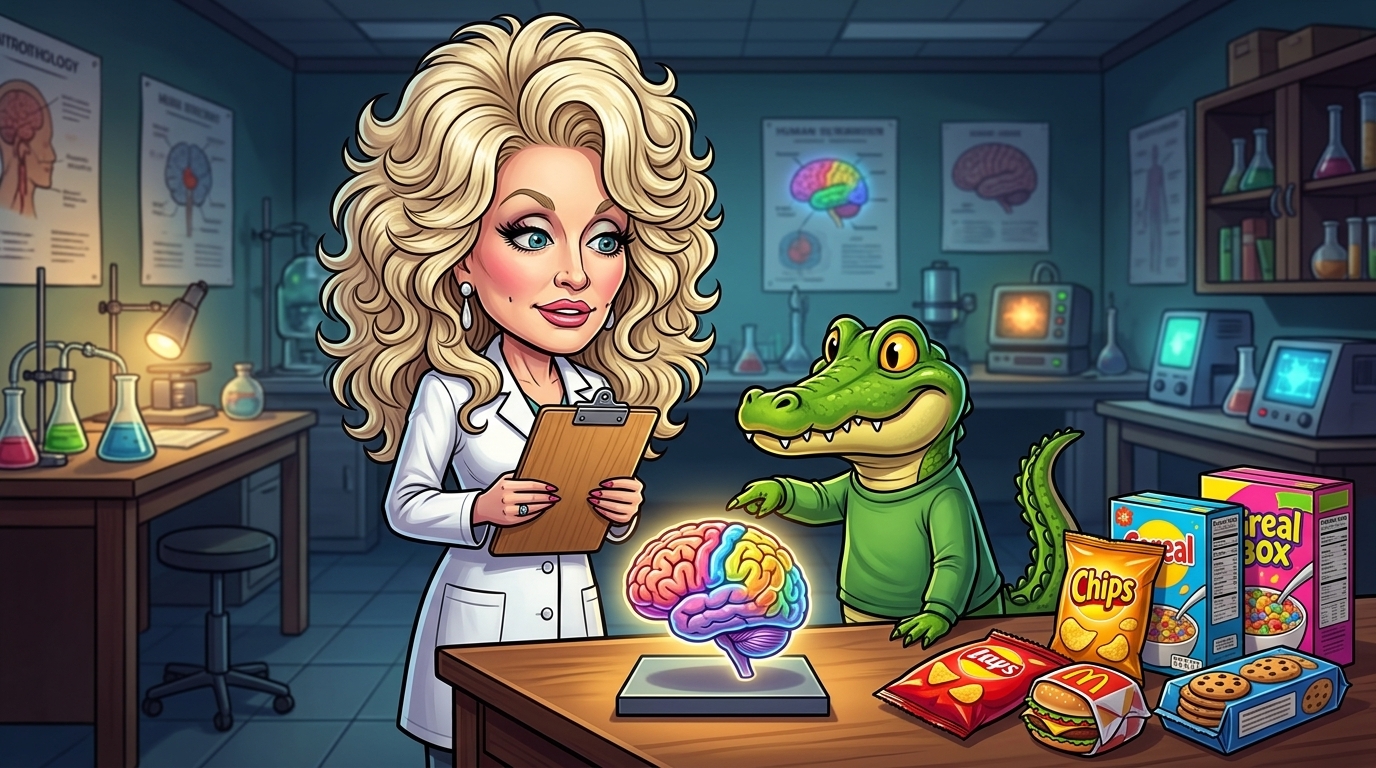
I’m going to be straight with you: this headline sounds terrifying. So let me give you the whole picture before you spiral about every cracker your kid has ever eaten.
Researchers at Children’s Hospital Los Angeles, publishing in The American Journal of Clinical Nutrition in June 2026, found that children who ate more ultra-processed foods in early childhood showed measurable differences in brain structure by age six. A 10% higher cumulative intake was associated with nearly 2% lower volume in subcortical structures including the accumbens, amygdala, pallidum, putamen, and thalamus — regions involved in reward processing, emotion, and motivation.
What they did not find
This is the part that got lost in the headlines. There was no link between ultra-processed food intake and cognitive performance. The children’s thinking, learning, and problem-solving scores were the same regardless of diet.
As senior author Dr. Michael I. Goran put it: “Even without differences in cognitive performance, we’re seeing measurable changes in brain structure.”
That is a real finding. It is not “your kid isn’t as smart.” Nobody’s data says that.
Now the limitations — because they matter
I promised you I’d never oversell a study, so here’s the honest accounting.
This was a prospective cohort of 144 Latino and Hispanic mother–infant pairs, with dietary recalls at 6, 12, 24, and 72 months and brain imaging at 72 months. That is a small, ethnically specific sample. It is observational, which means it shows an association, not that ultra-processed food caused the difference. And we do not yet know whether a 2% volume difference carries any consequence down the road.
Anyone telling you this study proves UPFs damage children’s brains is going further than the researchers did. The lead author, Dr. Jonatan Ottino-González, and the team were careful. We should be too.
What Dr. Goran actually said is worth reading twice: “Our findings suggest that what children eat early in life may shape brain development in ways we’re just beginning to understand.”
“Suggest.” “May.” “Beginning to understand.” That’s a scientist being precise — telling us this is worth watching now, before we know the full story.
So why care at all?
Because of the baseline. According to CDC and National Center for Health Statistics data, 56.1% of the calories consumed by children ages 1 to 5 in the United States come from ultra-processed foods. For ages 6 to 11 it climbs to 64.8%.
We are not talking about the occasional birthday cupcake. We are talking about the majority of a small child’s diet, during the years the brain develops faster than at any other point in life.
You don’t need certainty about the long-term effects to think that’s worth paying attention to.
This is not about guilt
Every parent I know is doing their best with the time, money, and energy they actually have. The food system is not built to help you — it’s built to sell you convenience.
This study doesn’t say you failed. It says this matters more than we knew, and the research is still catching up.
And the good news is you can act on it today. No federal definition required. No nutrition degree. No overhauling your entire kitchen on a Tuesday.
You just need to know what’s in the package
Scan any barcode and see how processed a food actually is — NOVA level, Gator Grade, flagged ingredients — before it goes in the cart. Not fear. Just facts.
Download Rock The New Food Pyramid. Scan your groceries. Know what you’re feeding your family.
The science is telling us early nutrition may shape the brain. The least we can do is know what we’re handing them. 🐊
References
Ottino-González, J., et al. (2026). Early-life cumulative intake of ultra-processed foods and subcortical brain volume at age six years: A prospective cohort study. The American Journal of Clinical Nutrition. https://doi.org/10.1016/j.ajcnut.2026.101350
Children’s Hospital Los Angeles. (2026). Ultra-processed foods linked to brain differences in young children. https://www.chla.org/blog/experts/research-and-breakthroughs/ultra-processed-foods-linked-brain-differences-young-children
National Center for Health Statistics. (2025, August). Ultra-processed food consumption in youth and adults: United States, August 2021–August 2023 (NCHS Data Brief No. 536). Centers for Disease Control and Prevention. https://www.cdc.gov/nchs/products/databriefs/db536.htm
Rock The New Food Pyramid — Scan. Know. Choose Better.