
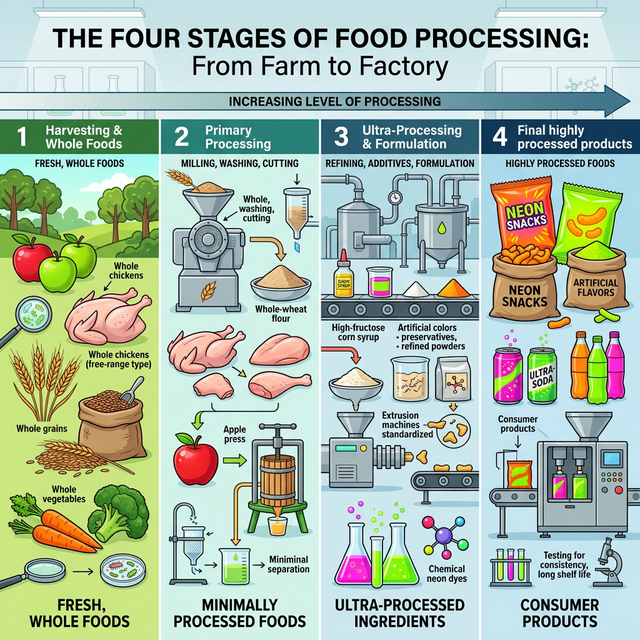
You've probably heard the term "ultra-processed food" in the news lately. But what does it actually mean? How is it different from just "processed"? And why should you care?
The answers come from a system called NOVA — the internationally recognized food classification framework developed by researchers at the University of São Paulo and endorsed by the United Nations' Food and Agriculture Organization (FAO), the Pan American Health Organization, and the World Health Organization.
NOVA doesn't look at calories, fat, or sugar. Instead, it classifies foods by how much industrial processing they've undergone. And that distinction turns out to be one of the most important factors in determining whether a food is actually good for you.
The 4 NOVA Groups
Group 1: Unprocessed or Minimally Processed Foods
These are foods that come directly from plants or animals with little to no alteration. Think fresh fruits, vegetables, eggs, meat, fish, milk, legumes, nuts, and grains. Minimal processing includes things like washing, peeling, refrigerating, pasteurizing, or freezing — processes that don't add any new substances to the food.
Examples: Fresh chicken breast, an apple, brown rice, plain yogurt, dried beans, frozen broccoli.
Group 2: Processed Culinary Ingredients
These are substances extracted from Group 1 foods and used in cooking. Oils, butter, sugar, salt, flour, and vinegar fall here. They're rarely eaten on their own — they're used to prepare and season Group 1 foods.
Examples: Olive oil, butter, honey, table salt, wheat flour.
Group 3: Processed Foods
These are Group 1 foods that have been altered using Group 2 ingredients — typically by canning, bottling, or simple preservation methods. They usually have 2-3 ingredients. Processing here is meant to increase durability or enhance flavor, not to create a new product from scratch.
Examples: Canned beans (beans + water + salt), artisan bread (flour + water + yeast + salt), cheese, canned tuna in oil, pickled vegetables.
Group 4: Ultra-Processed Foods ⚠️
This is where it gets concerning. Ultra-processed foods are industrial formulations made mostly or entirely from substances derived from foods and additives. They typically contain 5+ ingredients, many of which you'd never find in a home kitchen: high-fructose corn syrup, hydrogenated oils, modified starches, flavor enhancers, emulsifiers, humectants, and artificial colors.
These products are designed to be hyper-palatable (so you can't stop eating them), have a long shelf life, and be extremely profitable. They're engineered in laboratories, not cooked in kitchens.
Examples: Soft drinks, packaged snacks, instant noodles, chicken nuggets, hot dogs, flavored yogurts, breakfast cereals, energy bars, frozen meals, infant formula, meal replacement shakes.
Why Ultra-Processed Foods Are Dangerous
A growing body of research links ultra-processed food consumption to:
- Obesity — UPFs are designed to override your body's satiety signals
- Type 2 diabetes — high glycemic additives spike blood sugar
- Heart disease — hydrogenated oils, excess sodium, and inflammatory additives
- Cancer — multiple studies link UPF consumption to increased colorectal, breast, and pancreatic cancer risk
- Depression and anxiety — gut-brain axis disruption from artificial additives
- Early death — a 2024 BMJ study of 114,000 adults found that higher UPF consumption was associated with a 14% increased risk of death from all causes
The Sneaky Part: Marketing
Here's what makes ultra-processed foods particularly dangerous: they're often marketed as healthy.
Granola bars, flavored yogurts, whole-grain cereals, protein shakes, veggie chips — all of these commonly land in NOVA Group 4. The packaging says "natural," "whole grain," "made with real fruit," or "heart healthy." But flip them over and read the ingredient list. If you see ingredients you can't pronounce, substances that sound like chemistry, or a list longer than 10 items — you're likely holding an ultra-processed product.
Check Any Food Instantly
Want to know the NOVA classification of a specific food? That's exactly what Rock the New Food Pyramid does. Search any food product and instantly see its NOVA group, hidden additives, and where it really falls on the new food pyramid.
No guessing. No marketing spin. Just the science.
References & Citations
- University of São Paulo (USP) Center for Epidemiological Studies in Health and Nutrition. The NOVA Food Classification System.
- National Academies of Sciences, Engineering, and Medicine (NASEM). Toxicology and Safety Assessments of Food Additives.