There is a straightforward question that most American parents have never been given a useful answer to: does the state where you live protect your child from harmful food additives in school meals?
The honest answer, as of early 2026, is: it depends enormously on where you live. And the gap between the most protective states and the least protective is not a matter of degree — it is categorical.
The Federal Floor Is Not Enough
School meal programs — the National School Lunch Program and School Breakfast Program — are federally funded and governed by USDA nutritional standards. Those standards address macronutrient composition, caloric limits, and food group representation. They do not, with limited exceptions, restrict the specific additives that food manufacturers may include in products sold to schools.
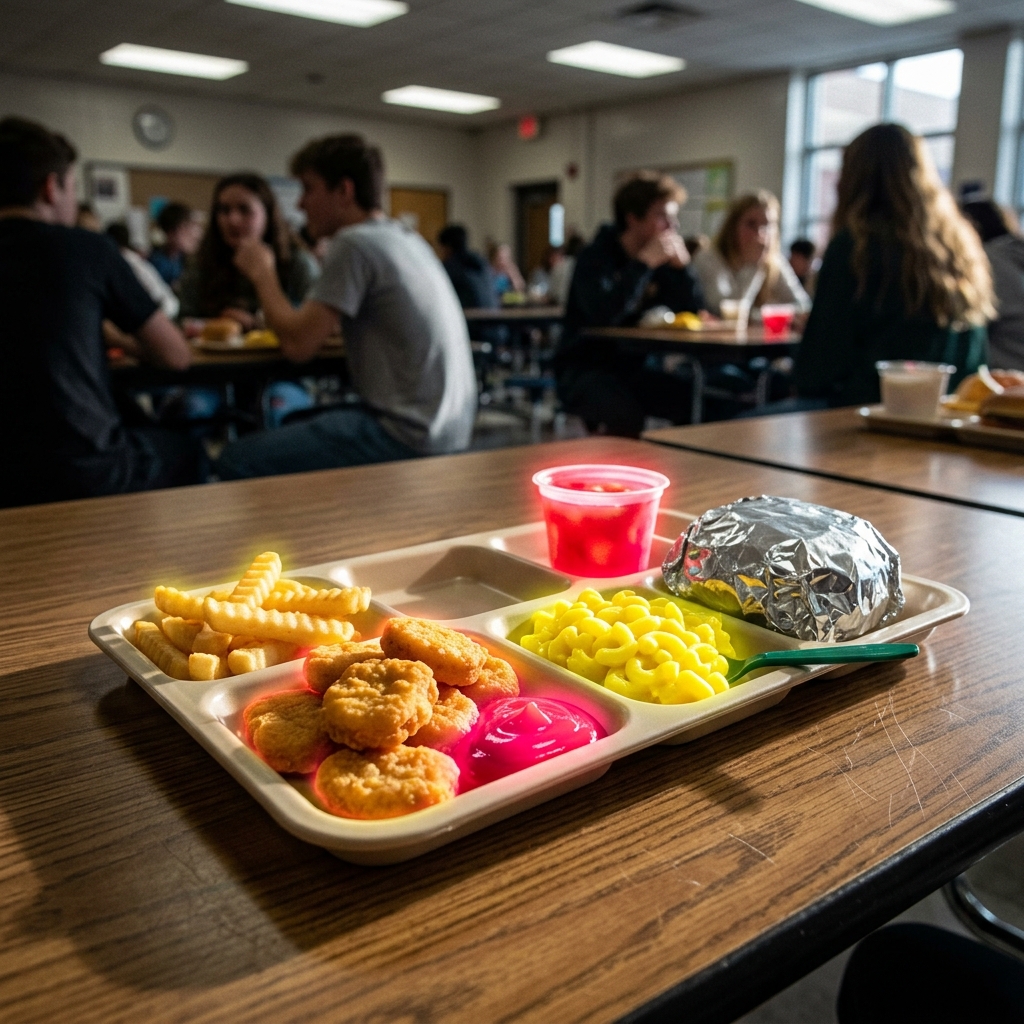
This means that a school lunch tray compliant with all federal standards can legally contain Red Dye No. 40 (linked to behavioral difficulties and hyperactivity in children), titanium dioxide (a whitening agent classified as possibly carcinogenic by the European Food Safety Authority), and sodium nitrite (a preservative associated with increased cancer risk) — provided the macronutrient profile meets USDA requirements.
The FDA's 2025 ban on Red Dye No. 3 explicitly excluded school meals from its initial compliance timeline. The federal government has taken no binding action to restrict the other synthetic dyes most commonly found in children's food.
Where States Are Leading
In the absence of federal action, a growing number of states have moved to establish their own restrictions on food additives in school meals — and in some cases, across all retail food products.
California has been the most aggressive. The California Food Safety Act (AB 418), enacted in 2023, banned four additives from all food products sold in the state. A follow-on law, the California School Food Safety Act (AB 2316), banned six synthetic dyes — Red 3, Red 40, Yellow 5, Yellow 6, Blue 1, and Blue 2 — specifically from food served in public schools.
West Virginia enacted legislation in 2025 banning the same six synthetic dyes from food sold at retail beginning in 2028, though enforcement was temporarily enjoined. The school nutrition component of the law remains intact.
Arizona, Louisiana, Texas, Utah, and Virginia all passed new food safety laws in 2025, focusing primarily on synthetic dyes and specific preservatives. More than 30 states introduced bills targeting ultra-processed food additives in 2025 alone, reflecting a broad and accelerating legislative movement.
Where States Are Not Acting — Yet
The majority of states have introduced no meaningful legislation restricting food additives in school meals or retail food products. In these states, children eating school lunch continue to be exposed to the full range of additives that federal standards permit — including substances that have been banned in comparable regulatory jurisdictions for years or decades.
Florida, for instance, has no state-level legislation restricting synthetic food dyes or other additives in school meals beyond federal minimums. This is not unusual among Southern states, where agricultural and food industry lobbying has historically been influential in state legislatures.
A child eating school lunch in California is protected from six synthetic food dyes. A child eating the same federally compliant meal in Florida is not. The food may be identical. The protection is not.
What Parents Can Do Right Now
The legislative map is changing rapidly, but parents cannot wait for their state legislature to act. There are practical steps available now.
- Request your school district's approved vendor list and compare products against ingredient databases that flag high-concern additives. Many school districts are required to make this information available upon request.
- Familiarize yourself with the highest-concern synthetic dyes: Red 40, Yellow 5, Yellow 6, and Blue 1 are the most prevalent in children's food products and have the most substantial body of evidence linking them to behavioral effects in sensitive children.
- Potassium bromate and propyl paraben are less commonly discussed but appear in baked goods and packaged foods in school meal programs — both are banned in the EU.
- Use additive-checking tools — including our Dirty 25 guide — to evaluate packaged foods you send in lunches or purchase for home consumption.
- Engage your school board. In many districts, individual parents and small coalitions have successfully advocated for the removal of specific high-concern additives from school meal menus, often by pointing to the precedent set in California and West Virginia.
The Broader Stakes
The food your child eats in school during their K-12 years is not a peripheral nutritional concern. School meals represent a significant portion of daily caloric intake for millions of American children, including the 30 million who participate in the National School Lunch Program.
The question of what states allow to be served to children in publicly funded school meals is, ultimately, a question about what we as a society consider acceptable exposure. The answer, in most American states today, is: more than most comparable countries permit.
Protect Your Kids' Plates
It shouldn't depend on your zip code whether your child is exposed to harmful additives. But while state legislatures catch up to the science, parents can take immediate action to protect their families.
The Rock The New Food Pyramid app is your first line of defense. By scanning lunchbox staples and pantry items, you can instantly check them against the Dirty 25 additive list. The app identifies the synthetic dyes and dough conditioners that the government still permits, and offers safe, kid-friendly swaps.
Take back control of your family's nutrition. Download RTNFP and start packing lunches you can trust.
References & Citations
- University of São Paulo (USP) Center for Epidemiological Studies in Health and Nutrition. The NOVA Food Classification System.
- National Academies of Sciences, Engineering, and Medicine (NASEM). Toxicology and Safety Assessments of Food Additives.