I want to tell you about a bag of crackers.
The crackers were on the shelf at eye level — which costs the manufacturer about $35,000 a year per store, by the way, but that is a different blog post. They had a cartoon farm on the front. The word WHEAT in a font that made you feel safe. A green leaf graphic. A claim, in small print: Made with whole grains.
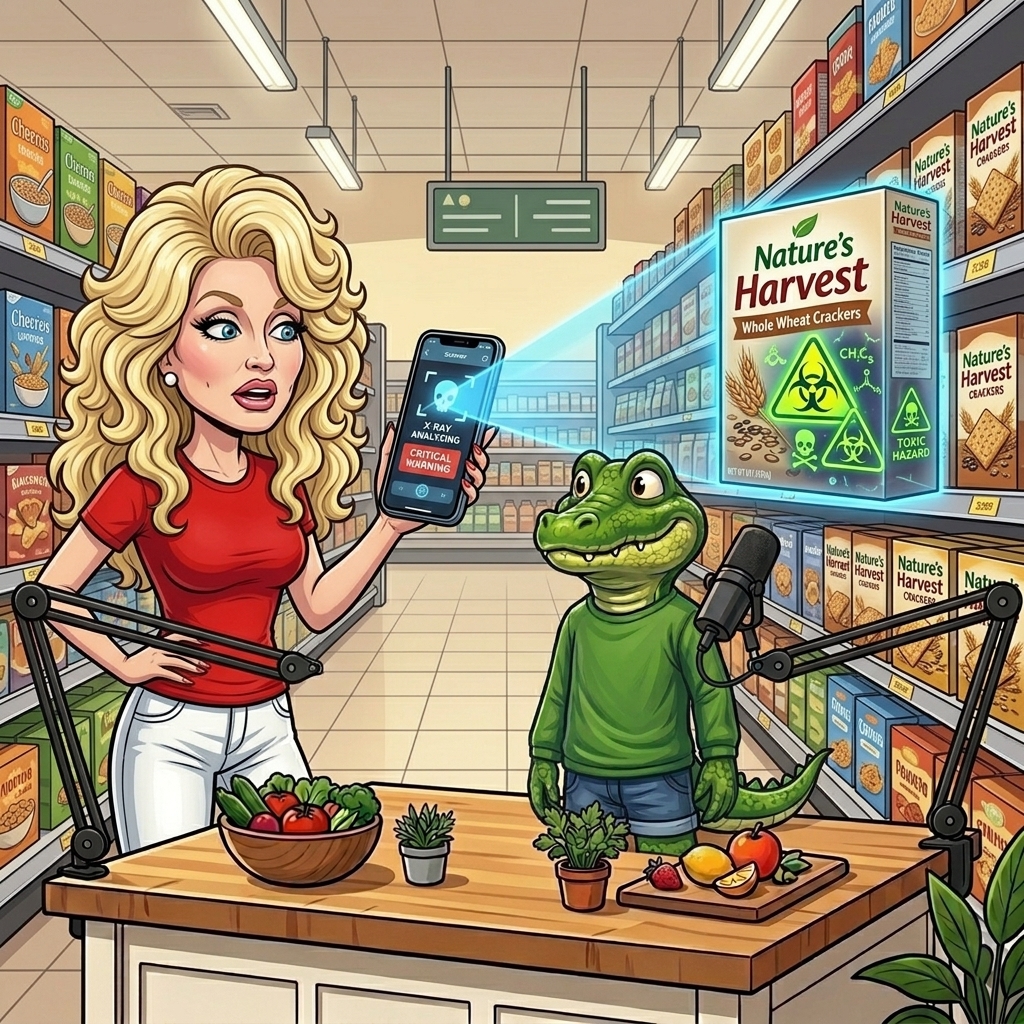
I scanned them. Twelve seconds. NOVA 4.
This is not a story about that one bag of crackers. It is a story about an entire aisle. Possibly most of your pantry. And it is the reason we built the dual NOVA scan into Rock The New Food Pyramid in the first place.
The healthy-halo problem
There is a class of food products engineered to look healthy. Not to be healthy — to look healthy. The cartoon farm. The "made with" claim that tells you nothing. The earthy-toned packaging. The font that whispers, we are not the bad guys.
The technical term in marketing literature is the health halo effect. One healthy-sounding signal on the front of a package — a green leaf, a grain stalk, the word "natural" — causes consumers to assume the entire product is healthier than it is. A meta-analysis in the Journal of Consumer Research (Schuldt, 2013) found that health halo claims caused consumers to underestimate calorie and additive content by 18 to 25 percent on average.
Eighteen to twenty-five percent. That is not a rounding error. That is, often, the entire difference between what a product looks like on a shelf and what it actually is in your body.
Here is what the food industry knows and most consumers do not: front-of-package marketing is barely regulated. The FDA regulates the Nutrition Facts panel — that is the boring table on the back — but the cartoon farm, the green leaf, the "made with" claim operate under a much looser standard. The standard is essentially: do not say anything provably false. So they do not lie. They imply things that are not true, in arrangements designed to make you assume.
I know how this works because I spent my professional career studying it.
What the ingredient list will and will not tell you
If you want to know what is actually in your food, the ingredient list on the back panel is the closest thing to honesty you are going to find. But — and this is critical — ingredient lists are designed in a way that makes the information hard to use in real time. Three reasons.
1. Ingredients are listed by weight, not by impact. A trace amount of a potent additive shows up at the end of the list, looking insignificant. The body does not experience it that way. A milligram of an azo dye does not read as "less concerning" to a child's nervous system because it weighs less than the wheat flour.
2. Many additives have multiple legal names. Sugar alone has dozens of names manufacturers can legally use on a label — the University of California San Francisco's SugarScience initiative documents more than 60 of them (UCSF SugarScience, n.d.). Maltodextrin, dextrose, evaporated cane juice, brown rice syrup, agave nectar — these are all functionally sugar, but split across an ingredient list, none of them rise to the top.
3. "Natural flavors" and "spices" hide entire chemistry cabinets. These two phrases are legal aggregators. Behind a single use of the words natural flavors, a product can contain dozens of distinct chemical compounds, including ultra-processed solvents and carriers used to deliver the flavor (Code of Federal Regulations, 21 CFR § 101.22, 2024).
So even if you do the right thing — flip the package over, read the back — the information is, by design, hard to use.
This is the gap the barcode scanner fills.
What the dual NOVA scan actually does
When you scan a barcode in the Rock The New Food Pyramid app, three things happen in about five seconds.
First, the scanner pulls the product's full ingredient list from a verified product database. Not the front-of-package summary. The actual back-of-pack ingredient declaration submitted by the manufacturer.
Second, every individual ingredient is classified against the NOVA scale — the peer-reviewed framework developed by Dr. Carlos Augusto Monteiro and the team at the Center for Epidemiological Research in Nutrition and Health, University of São Paulo (Monteiro et al., 2019). NOVA 1 ingredients (whole foods, minimally processed) are flagged green. NOVA 2 (culinary ingredients — salt, oils, sugar) are flagged yellow. NOVA 3 (processed foods like cured meats and canned fish) are flagged amber. NOVA 4 (ultra-processed industrial substances) are flagged red.
Third, the scan returns an overall score for the product and the individual breakdown, so you can see exactly which ingredients are dragging the score down.
This is the dual scan: the overall NOVA classification plus the ingredient-by-ingredient breakdown. Other apps that flag ultra-processed foods stop at the overall score. We do not, because the breakdown is the part that actually changes behavior. It is the difference between knowing a product is ultra-processed and knowing why — and the why is what tells you whether you can swap one ingredient and salvage the recipe, or whether you need to walk away from the brand entirely.
Three real examples I scanned this week
I went into my own pantry. I scanned twelve products I had assumed were fine. Here are three that were not.
The "whole grain" cracker. Front of package: cartoon farm, WHOLE GRAIN in green caps, "no artificial colors." Back of package: enriched flour as the first ingredient (which is not whole grain — it is refined wheat with vitamins added back in after they were processed out), high-fructose corn syrup, maltodextrin, soy lecithin, two preservatives, and "natural flavors." Overall scan: NOVA 4. The whole-grain claim was based on a small amount of whole wheat flour appearing later in the ingredient list.
The "fruit-on-the-bottom" yogurt. Marketed at kids. The fruit on the bottom was, by weight, mostly sugar, modified corn starch, and natural and artificial flavors. The yogurt itself contained pectin, gelatin, and a stabilizer system that put the product squarely in NOVA 4 territory before you got to the "fruit." Plain Greek yogurt with a spoonful of real preserves would have scanned NOVA 1 or 2. The branded children's version was NOVA 4.
The "veggie" straws. I will be honest about this one — they are a regular in my own house. The primary ingredient is potato starch. The second is corn starch. The "vegetables" are a small amount of spinach powder and beet powder, used for color, not nutrition. Overall scan: NOVA 4. The actual vegetable content is so low that you would have to eat the entire bag to equal the spinach in two leaves of fresh spinach.
I am not telling you these stories to make anyone feel guilty about anything in their house. I am telling you because if these three products could fool me — and I built a platform around this — they can fool anyone. They are designed to.
What to do with the information
The scanner is not a tool of judgment. It is a tool of clarity. Here is how I recommend using it.
For adults: scan once, learn the brand. You do not need to scan the same product every time. Scan once, learn what the brand is doing, and adjust. Within two weeks of regular scanning, most people develop a reliable internal map of which brands in their regular rotation are clean and which are not. Scanning frequency drops naturally.
For groceries: scan the new things. Anything entering the cart for the first time, scan it. This is where the marketing machine catches you — on the new product, the rebrand, the "improved formula." Five seconds at the shelf saves you from a year of feeding your family something you would not have bought if you had known.
For kids: be careful here. My co-host on Fresh Talk, Imani Bell, is a family nurse practitioner, and she has a point I want to underline. Information is good. Fear is not. A growing body of clinical literature has identified orthorexia — disordered eating driven by anxiety about food "purity" — in increasingly younger children, including school-age kids (Cena et al., 2019). Younger children should not be the ones doing the scanning. The adult scans, decides, and translates the decision into a calm, neutral statement: We are going to try a different brand this week. No drama. No "this is bad food." Just a quiet substitution. Older children — twelve and up — can scan with you, and many of them love it. It puts the analytical part of their brain in charge instead of the snack-craving part.
The bigger point
Front-of-package marketing has had thirty years to evolve. It is sophisticated. The cartoons, the colors, the claims, the placement on the shelf — every piece of it is engineered, and most of it is engineered to deceive without technically lying.
The scanner is the counter-move. It bypasses the marketing entirely and goes to the ingredients. It is the first time, frankly, that the consumer has had a real-time information tool that matches what the industry has had for half a century.
Use it. Carefully. With the emotional well-being of your kids in mind. But use it.
The food industry won the last fifty years because it had information you did not. That asymmetry just ended.
---
References
Cena, H., Barthels, F., Cuzzolaro, M., Bratman, S., Brytek-Matera, A., Dunn, T., Varga, M., Missbach, B., & Donini, L. M. (2019). Definition and diagnostic criteria for orthorexia nervosa: A narrative review of the literature. Eating and Weight Disorders, 24(2), 209–246. https://doi.org/10.1007/s40519-018-0606-y
Code of Federal Regulations. (2024). Foods: Labeling of spices, flavorings, colorings and chemical preservatives, 21 C.F.R. § 101.22. U.S. Food and Drug Administration.
Monteiro, C. A., Cannon, G., Levy, R. B., Moubarac, J.-C., Louzada, M. L., Rauber, F., Khandpur, N., Cediel, G., Neri, D., Martinez-Steele, E., Baraldi, L. G., & Jaime, P. C. (2019). Ultra-processed foods: What they are and how to identify them. Public Health Nutrition, 22(5), 936–941. https://doi.org/10.1017/S1368980018003762
Schuldt, J. P. (2013). Does green mean healthy? Nutrition label color affects perceptions of healthfulness. Health Communication, 28(8), 814–821. https://doi.org/10.1080/10410236.2012.725270
UCSF SugarScience. (n.d.). Hidden in plain sight: Added sugar is hiding in 74% of packaged foods. University of California, San Francisco. https://sugarscience.ucsf.edu/hidden-in-plain-sight