
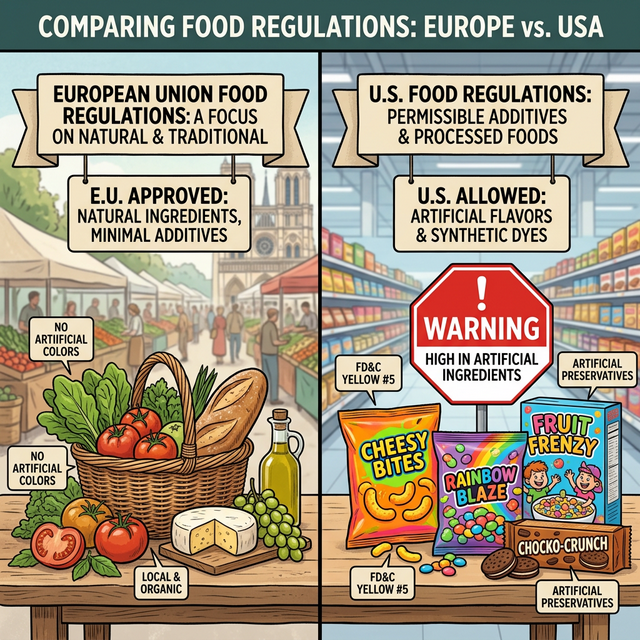
If you walked into a grocery store in Paris, London, or Berlin, certain ingredients on American shelves would be illegal. Not regulated. Not limited. Banned.
The European Union operates under the precautionary principle: if there's credible evidence that a substance could harm human health, it's removed from the food supply until proven safe. The United States takes the opposite approach — substances are assumed safe until proven dangerous, often after decades of public exposure.
Here are 5 ingredients that are banned in multiple countries but still perfectly legal in your American grocery store right now.
1. Titanium Dioxide (E171)
What it is: A white pigment — the same chemical used in white paint, sunscreen, and plastics — added to food to make it look whiter and more appealing.
Where you'll find it: Skittles, Pop-Tarts frosting, coffee creamer, cake frosting, chewing gum, and hundreds of candies marketed to children.
Why it's banned: The European Food Safety Authority (EFSA) concluded in 2021 that titanium dioxide can no longer be considered safe as a food additive, citing concerns about genotoxicity — the ability to damage DNA. The EU banned it in food products effective August 2022.
US status: Still legal. Still widely used. The FDA has not taken action.
2. Potassium Bromate
What it is: A chemical added to bread and baked goods to make dough stronger and rise higher.
Where you'll find it: Commercial bread, rolls, pizza dough, and baked goods — especially fast-food buns.
Why it's banned: The International Agency for Research on Cancer (IARC) classifies potassium bromate as a Group 2B carcinogen (possibly carcinogenic to humans). It's been banned in the EU, UK, Canada, Brazil, China, South Korea, and many other countries.
US status: Legal at the federal level. California required a warning label as of 2023, but has not banned it outright.
3. BHA (Butylated Hydroxyanisole)
What it is: A synthetic preservative used to prevent fats and oils from going rancid.
Where you'll find it: Cereal, chips, chewing gum, frozen sausages, snack foods, butter, and even cosmetics.
Why it's banned: The US National Toxicology Program lists BHA as "reasonably anticipated to be a human carcinogen." California's Proposition 65 lists it as a known carcinogen. It's banned or severely restricted in the EU, Japan, and Australia.
US status: Still listed as "Generally Recognized as Safe" (GRAS) by the FDA.
4. Red Dye #3 (Erythrosine)
What it is: A synthetic red food coloring derived from petroleum.
Where you'll find it: Candy, cake frosting, maraschino cherries, popsicles, and some medications.
Why it's banned: The FDA itself acknowledged in 1990 that Red Dye #3 causes thyroid tumors in rats. It was banned in cosmetics and external drugs — but not in food. The EU has restricted its use. California passed a law in 2023 banning it from foods sold in the state, effective 2027.
US status: Still legal in food at the federal level. The FDA finally moved to revoke its authorization in January 2025, with a phase-out period.
5. Brominated Vegetable Oil (BVO)
What it is: Vegetable oil modified with bromine, used to keep citrus flavoring evenly distributed in beverages.
Where you'll find it: Historically found in Mountain Dew, Fanta, Sun Drop, and other citrus-flavored sodas and sports drinks.
Why it's banned: Bromine is a toxic element. Studies have linked BVO to neurological damage, memory loss, skin lesions, and thyroid problems. It's been banned in the EU, Japan, and India for decades.
US status: The FDA finally revoked its authorization in July 2024, giving manufacturers one year to reformulate. But it took decades of consumer advocacy to get there — and Americans consumed it for years after other countries had already banned it.
Why Are American Families Last to Be Protected?
The pattern is clear: other countries identify a health risk, ban the substance, and protect their citizens. The US waits — sometimes for decades — while its population continues to be exposed.
You shouldn't have to wait for the FDA to catch up. You can check your food right now.
Rock the New Food Pyramid flags these additives instantly. Search any food product and see what's hiding on the label — including whether its ingredients have been banned in other countries.
References & Citations
- University of São Paulo (USP) Center for Epidemiological Studies in Health and Nutrition. The NOVA Food Classification System.
- National Academies of Sciences, Engineering, and Medicine (NASEM). Toxicology and Safety Assessments of Food Additives.