
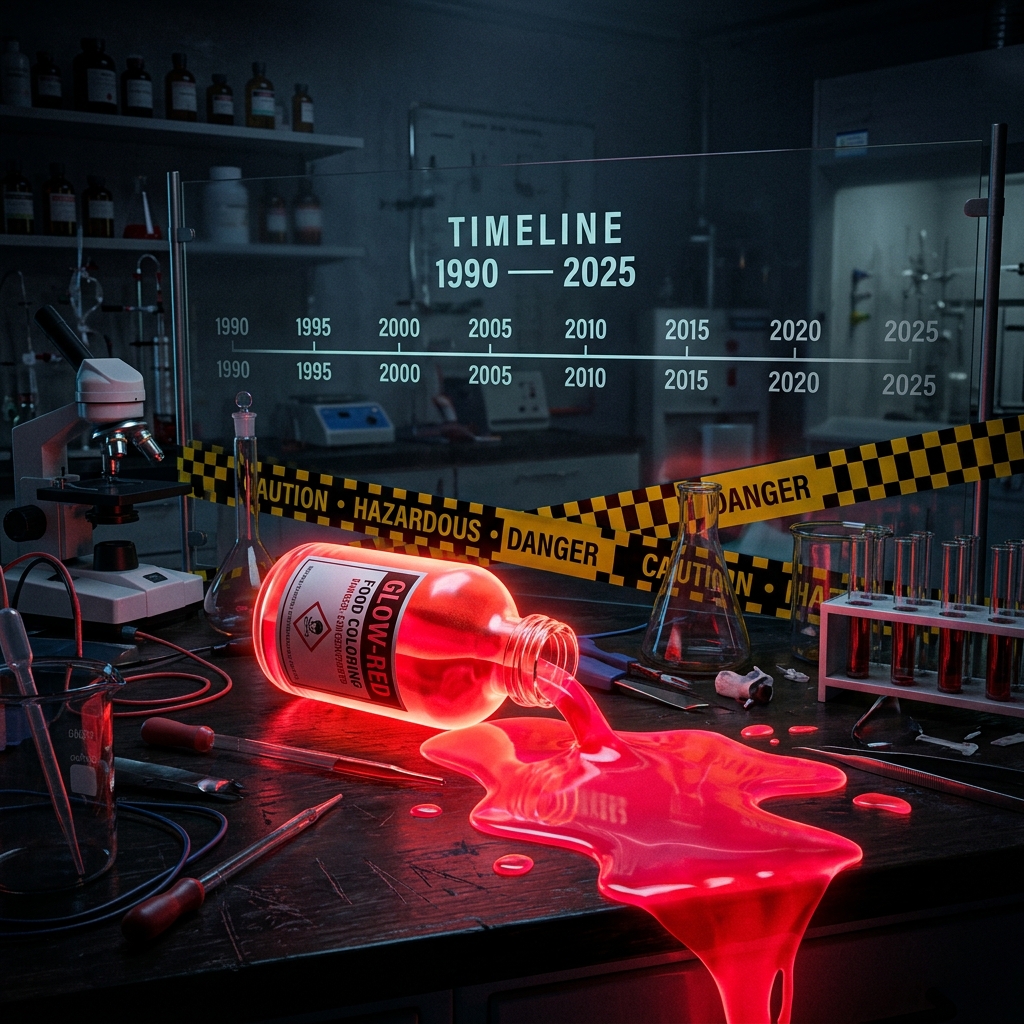
Here is a timeline worth sitting with.
- 1990: The FDA bans Red Dye No. 3 — erythrosine, a synthetic petroleum-derived dye — from cosmetics and externally applied drugs. The reason: evidence of carcinogenicity. Under the Delaney Clause, a 1958 provision of federal food safety law, the FDA is legally prohibited from approving any food additive shown to cause cancer in humans or animals.
- 1990 to 2025: Red Dye No. 3 remains legal in food products for thirty-five years, including candy, maraschino cherries, and processed foods consumed predominantly by children.
- January 2025: The FDA finally bans Red Dye No. 3 from food, giving manufacturers until 2027 to reformulate.
The FDA knew. The law was clear. The cancer evidence was the same evidence that had already triggered a cosmetics ban. And for thirty-five years, American children kept eating it.
The Delaney Clause: A Legal Obligation the FDA Simply Ignored
The Delaney Clause does not give the FDA discretionary authority to weigh costs and benefits when a carcinogen is detected in a food additive. It mandates a ban. When the FDA banned Red 3 from cosmetics in 1990, it simultaneously acknowledged that the same legal obligation applied to its use in food — but cited administrative burden and economic disruption to the food industry as reasons to delay action.
What followed was not a rigorous ongoing safety review. It was regulatory inertia, sustained across multiple administrations and FDA leadership tenures, while the food industry continued to profit from a carcinogen it had been explicitly warned about.
Consumer advocacy organizations spent decades filing petitions. The scientific consensus did not change. The FDA took no meaningful action until California passed AB 418 in 2023, forcing the federal agency's hand by threatening to create an unworkable patchwork of state-by-state compliance requirements.
Red Dye No. 3 Is Not an Isolated Case
Brominated vegetable oil (BVO) — a flame retardant compound used as an emulsifier in citrus-flavored sodas — was approved as GRAS in the 1950s. By the 1970s, evidence of neurological harm had emerged. The FDA banned BVO in July 2024 — approximately seventy years after its approval and fifty years after problems first emerged.
Potassium bromate, used as a flour improver in bread baking, has been classified as a possible human carcinogen. It has been banned in the UK, the European Union, Canada, Brazil, and China. It remains legal in the United States.
Azodicarbonamide — the "yoga mat chemical" used as a dough conditioner — is linked to respiratory sensitization. The EU, UK, and Australia prohibit its use in food. In the United States, it remains approved by the FDA.
The pattern is consistent: substances banned for years or decades in comparable regulatory systems around the world continue to be used in American food, protected by a combination of industry lobbying and regulatory inertia.
Why the EU-US Gap Matters
The EU operates under a precautionary principle: when evidence of potential harm exists, the burden falls on manufacturers to demonstrate safety before a substance is approved. The U.S. system largely inverts this — substances are presumed safe until proven otherwise.
The consequence: the U.S. food supply contains approximately 10,000 approved additives. The EU permits roughly 400. That gap is not explained by superior American nutritional science. It is explained by a regulatory system shaped by industry influence.
What Responsible Food Labeling Should Tell You
The FDA's 2025 ban on Red Dye No. 3 gives manufacturers until January 2027 to comply. That means products containing Red 3 are still legally on store shelves today. Without mandatory front-of-pack disclosure, there is no simple way for consumers to identify them at a glance.
This is exactly the kind of gap that independent food transparency tools are designed to address. Cross-referencing ingredient lists against the Dirty 25 and NOVA processing scores gives consumers a practical, science-backed framework for identifying compromised products regardless of FDA action.
Don't Wait on the Regulators
The 35-year saga of Red Dye No. 3 proves one thing: you cannot rely on federal agencies to swiftly remove dangerous chemicals from the food supply. You have to be your own advocate.
But you don't have to memorize a chemistry textbook to do it. The Rock The New Food Pyramid app does the heavy lifting for you. Scan any product, and the app will instantly flag Red 3, along with other known carcinogens and harmful additives that are still legally sitting on store shelves today.
Stop waiting for the FDA to protect you. Download the RTNFP app and take your health into your own hands.
References & Citations
- University of São Paulo (USP) Center for Epidemiological Studies in Health and Nutrition. The NOVA Food Classification System.
- National Academies of Sciences, Engineering, and Medicine (NASEM). Toxicology and Safety Assessments of Food Additives.