
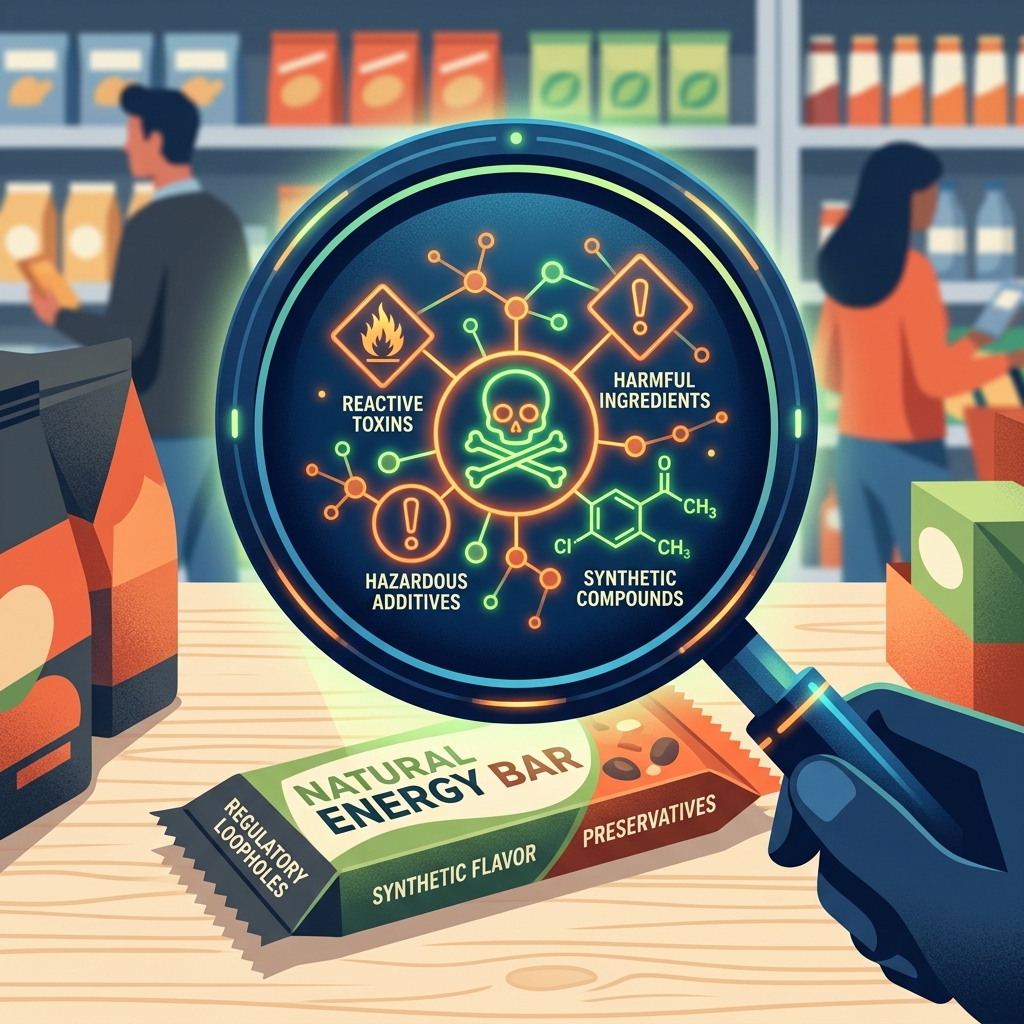
You check the ingredient label. You see words like "green tea extract," "mushroom extract," or "cinnamon extract" and think: natural, harmless, probably good for me. But what if the government has never actually verified that those specific ingredients — in those specific concentrations, extracted through those specific industrial processes — are safe to eat?
A landmark March 2026 investigation by the Environmental Working Group (EWG) revealed that at least 111 food chemicals have been added to the U.S. food supply without ever notifying the FDA. Of those, 49 have been identified as ingredients in thousands of grocery products currently on store shelves. Sports drinks. Snack bars. Cereals. Protein powders. Foods many Americans consume daily.
This is not a hypothetical loophole. It is an active, ongoing practice — and it is completely legal.
The GRAS Loophole: A System Designed for Salt and Yeast, Exploited for Industrial Chemicals
When Congress passed the Food Additives Amendment in 1958, it created an exemption for substances "generally recognized as safe" — the now-infamous GRAS designation. The intent was narrow and sensible: basic kitchen staples like vinegar, salt, and yeast didn't need FDA pre-market approval because their safety was already universally understood.
What Congress did not anticipate was that over subsequent decades, food and chemical companies would weaponize this exemption to introduce hundreds of novel, highly processed substances — including concentrated plant extracts, alternative proteins, and proprietary chemical compounds — by simply declaring their own products safe. No independent review. No FDA sign-off. Often, no public disclosure at all.
In 1997, the FDA made the problem worse by creating a voluntary notification system. Companies could notify the FDA about their GRAS determinations if they chose to — but weren't required to. And critically, if the FDA raised safety concerns, a company could simply withdraw its submission and continue selling the ingredient anyway, having never received a formal ruling.
"This is a wake-up call for every American who assumes the FDA is reviewing the safety of chemicals in their food. Instead, food and chemical companies are exploiting a loophole to keep both the government and the public in the dark."
— Melanie Benesh, VP of Government Affairs, Environmental Working Group
Expose the Secret Ingredients
The GRAS loophole means the food industry can legally keep you in the dark about hundreds of industrial chemicals in your snacks and drinks. But just because the FDA isn't looking doesn't mean you can't.
With the Rock The New Food Pyramid app, you have the ultimate magnifying glass. A quick barcode scan instantly flags those hidden additives, checking them against the Dirty 25 list and calculating the true NOVA score of the product. The app strips away the "natural extract" marketing and reveals the chemical reality.
Take the guesswork out of the grocery aisle. Download RTNFP and start spotting the secrets Big Food doesn't want you to see.
References & Citations
- University of São Paulo (USP) Center for Epidemiological Studies in Health and Nutrition. The NOVA Food Classification System.
- National Academies of Sciences, Engineering, and Medicine (NASEM). Toxicology and Safety Assessments of Food Additives.