Annie’s Homegrown is owned by General Mills.
RXBar is owned by Kellogg’s.
Applegate Farms is owned by Hormel.
Primal Kitchen is owned by Kraft Heinz.
Siggi’s Yogurt is owned by Lactalis — the largest dairy company in the world.
Health Warrior is owned by PepsiCo.
Bare Foods is owned by PepsiCo.
Bear Naked Granola is owned by Kellogg’s.
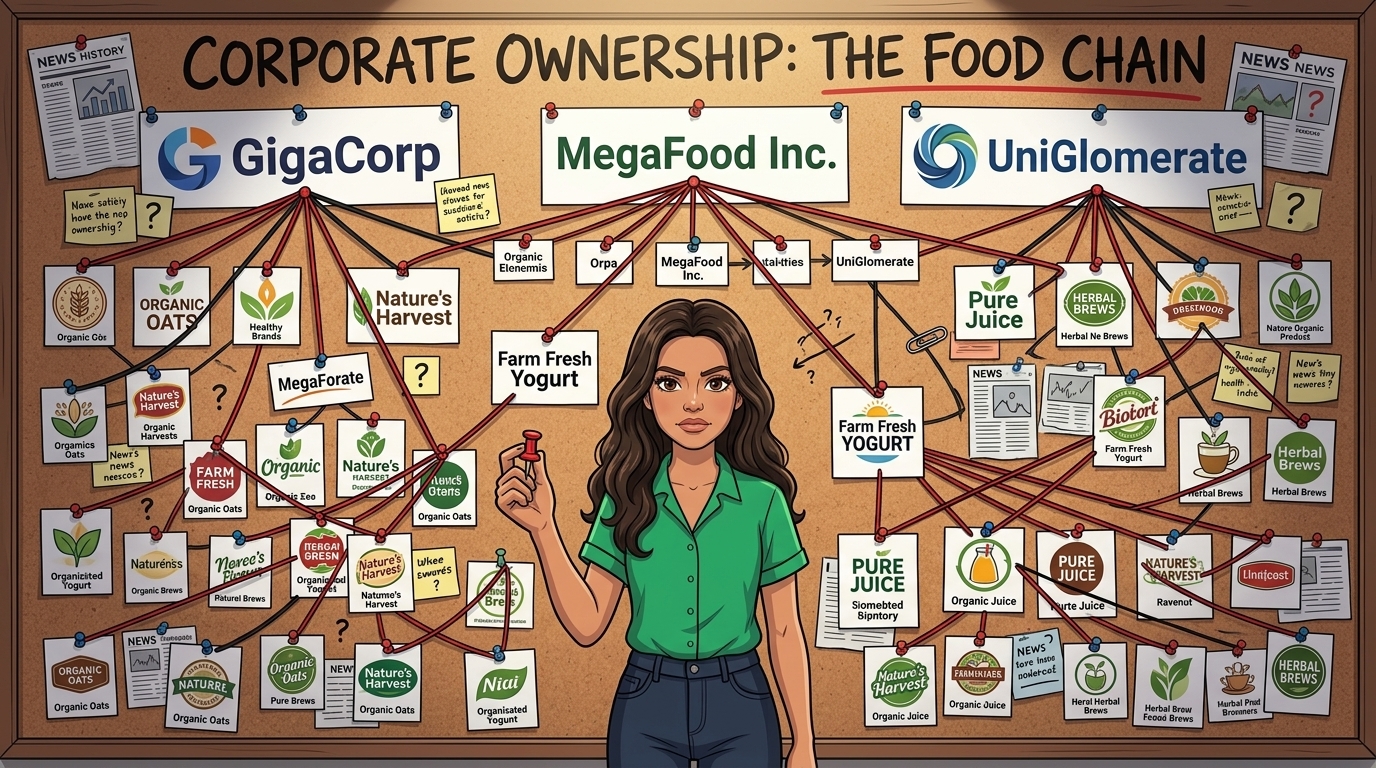
If those last few sentences surprised you, you are not unusual. Most American consumers cannot match major “healthy” or “natural” food brands to their corporate parents. That gap — between what you think you’re buying and where the money actually lands — is one of the most consistently exploited dynamics in modern food marketing.
Let me walk you through how this works. Because once you see the pattern, you cannot unsee it.
Why It Happens
Over the last fifteen years, virtually every major U.S. food and beverage conglomerate has built a portfolio of small, “natural,” “organic,” and “wellness-positioned” brands. The pattern is documented in SEC filings, in Bloomberg and Wall Street Journal M&A coverage, in academic work like Howard’s Concentration and Power in the Food System (Howard, 2021), and in tracking by the Cornucopia Institute, which maintains an ongoing brand-ownership chart (Cornucopia Institute, 2025).
The economic logic is dead simple.
Big Food has the manufacturing scale. The distribution networks. The shelf-placement leverage with grocery chains.
Small natural brands have the audience trust and the growth rates that traditional snacks and beverages can no longer reliably produce.
Acquisition is faster than building organic credibility from scratch. Buying trust is cheaper than earning it.
And the consumers who buy from these brands? Mostly don’t notice. The packaging usually doesn’t change. The story usually doesn’t change. The marketing doesn’t get a ticker symbol slapped on it.
What Actually Changes
Corporate acquisition is not automatically a death sentence for a brand’s quality. It just changes the incentives.
The Cornucopia Institute has tracked recipe changes at acquired brands for over a decade. Their findings:
- Some acquired brands maintain their original sourcing standards for years post-acquisition. Especially when those standards are part of the brand identity (organic certification, animal welfare claims, non-GMO verification).
- Many undergo what’s been called premium dilution — small, often imperceptible ingredient changes designed to lower per-unit costs while preserving the brand’s marketing position. Palm oil swapped in. “Natural flavors” added to extend shelf life. Sugar levels adjusted to match parent-company sweetness profiles.
- Some brands are functionally unchanged on the label but produced in shared manufacturing facilities with the parent company’s other products. Cross-contamination questions. Shared supply chains.
- A small but visible minority undergo substantial reformulation that materially changes the product. Sometimes consumers notice. Sometimes the brand never recovers.
The honest read: a brand under Big Food ownership is not always worse. But it is no longer protected by the survival pressure that made it good in the first place. A brand that previously had to maintain its quality reputation to stay in business now has the option to coast on it.
Some take that option. Others don’t.
You cannot tell which from the front of the package.
How to Read a Label, Regardless of Who Owns It
The most durable advice — the advice that survives every wave of acquisition and rebrand — is to read the ingredients first and the marketing second.
Ingredients first means:
- Look at the actual list, in order, before you look at any marketing claim.
- Ask whether you recognize all the ingredients as food.
- Count the chemical-sounding names.
- Note whether sweeteners, oils, or additives appear in the first three (which means they are substantial by weight).
- Check whether any of the Dirty 25 ingredients tracked at Rock The New Food Pyramid show up.
Marketing second means:
- “Natural” is not a regulated term in U.S. food labeling. It can mean almost anything.
- “Organic” is regulated — it’s a real signal, but it speaks only to ingredient sourcing, not processing level.
- “Made with real X” almost always means the product is mostly not X.
- "No artificial ___" tells you what isn’t there. Not what is.
- “Family-owned since [year]” might be technically true and corporate-owned today. Family pictures don’t expire when the LLC sells.
The label is the truth. The wrapper is the story.
The Acquisitions Worth Knowing
Some of the high-profile acquisitions of the last fifteen years, all verifiable through SEC filings:
Brand
Parent
Year
Annie’s Homegrown
General Mills
2014
RXBar
Kellogg’s
2017
Applegate Farms
Hormel
2015
Primal Kitchen
Kraft Heinz
2018
Siggi’s
Lactalis
2018
Health Warrior
PepsiCo
2018
Bare Foods
PepsiCo
2018
Krave Jerky
Hershey
2015
Boulder Brands (Smart Balance, EVOL, Udi’s)
Pinnacle → Conagra
2016
Bear Naked, Kashi
Kellogg’s
longstanding
Some of these brands have held the line. Others have not. The right move is not to boycott. It’s to read.
The Practical Takeaway
Don’t make any single brand your hero.
Don’t trust any wrapper without reading what is inside it.
Don’t assume the product you buy this year is the same one you bought five years ago.
Big Food has every incentive to maintain the appearance of consistency while quietly changing the product underneath. Your defense is the same one that protects you from every other category of food-marketing manipulation: read the label, scan the barcode, ask whether the ingredients look like food.
Trust the label, not the logo.
Want to cut through the brand-trust marketing playbook?
Rock The New Food Pyramid scans products and gives you the unfiltered ingredient breakdown — regardless of who owns the brand on the front. Real food doesn’t change ownership. Industrial products do.
RockTheNewFoodPyramid.com.
References
Cornucopia Institute. (2025). Who owns organic? Brand acquisition tracking chart. Retrieved from cornucopia.org
Howard, P. H. (2021). Concentration and power in the food system: Who controls what we eat? (Rev. ed.). Bloomsbury Academic.
General Mills, Inc. (2014). General Mills to acquire Annie’s [Press release].
Hormel Foods Corporation. (2015). Hormel Foods to acquire Applegate Farms [Press release].
Kellogg Company. (2017). Kellogg to acquire RXBAR [Press release].
Kraft Heinz Company. (2018). Kraft Heinz to acquire Primal Kitchen [Press release].
Lactalis Group. (2018). Lactalis acquires The Icelandic Milk and Skyr Corporation (siggi’s) [Press release].
PepsiCo, Inc. (2018). PepsiCo announcements on the acquisitions of Bare Foods and Health Warrior [Press releases].