
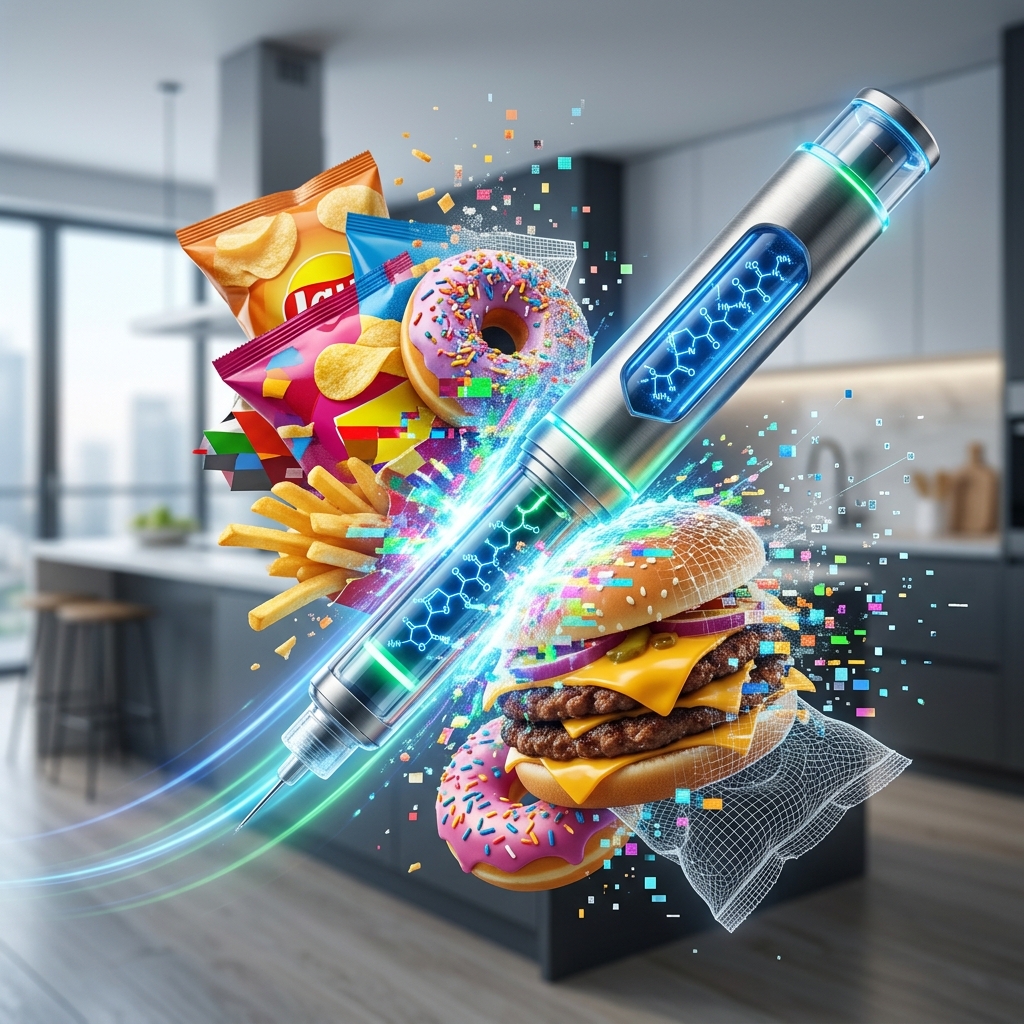
Something funny is happening in the packaged food industry.
Companies that have spent the last twenty years engineering products to be impossible to stop eating are now panicking about a class of drugs that makes people stop eating them.
Read that again.
For two decades, the food industry’s entire business model rested on a single quiet bet: hyperpalatable products would sell themselves because of how they were designed. Engineer the bliss point. Calibrate the crunch. Tune the salt-to-fat-to-sugar ratio. Get the chemistry right, and the eating takes care of itself.
Then GLP-1 drugs arrived. And it turns out that when you blunt the appetite signal those products were designed to hijack, the products lose their hook.
The food industry isn’t mad at the drugs.
The food industry is mad that the drugs are exposing the trick.
What GLP-1 Drugs Actually Do (and What That Reveals)
GLP-1 receptor agonists — Ozempic, Wegovy, Mounjaro, the next generation in the pipeline — work by mimicking a hormone the body produces in response to food. They slow gastric emptying. They reduce appetite. And critically, they appear to dampen the reward signaling associated with eating.
Patients on these drugs report something striking and consistent. They lose interest in ultra-processed foods specifically. Whole foods? Still appealing. Real meals? Still satisfying.
That is not random. That is the chemistry.
Ultra-processed foods were engineered around the appetite signals these drugs blunt. That is not a conspiracy theory — it is well documented in the food science literature. David Kessler, the former FDA commissioner who wrote The End of Overeating (Kessler, 2009), spent a whole book showing how the industry’s “bliss point” engineering — the precise calibration of fat, sugar, salt, and texture to maximize consumption — exploits specific neural reward pathways.
When a drug interrupts those pathways, the products designed around them stop working as designed.
Hall et al. (2019), in Cell Metabolism, demonstrated this from the other direction. In a randomized controlled metabolic-ward study at the National Institutes of Health, participants ate roughly 500 more calories per day on an ultra-processed diet than on a minimally processed one — with the diets matched for calories, fat, sugar, sodium, and fiber. The food itself was driving the overeating. That same overeating signal is what GLP-1s appear to silence.
Translation: the food industry has been formulating products against your biology this whole time. The drugs are just the first thing big enough to push back.
The Industry’s Visible Panic
In 2024, Nestlé launched a frozen-meal line called Vital Pursuit, marketed specifically to GLP-1 users (Nestlé S.A., 2024). Smaller portions. Higher protein. Lower calorie density. The phrase ultra-processed does not appear in their marketing. The product is, by NOVA classification, ultra-processed (Monteiro et al., 2019). It is just engineered to a different appetite signal than the previous generation of frozen meals.
That’s one example. There are dozens.
Conagra is reformulating product lines. General Mills is launching “GLP-1 friendly” snack lines. Kraft Heinz is repositioning entire brands. The Wall Street Journal and Bloomberg have been documenting the corporate scrambling for over a year. Industry analysts have estimated that GLP-1 users in some surveys reduce their spending on snack foods, sugary beverages, and frozen desserts by 25 to 50 percent. At population scale, that is an existential threat to several major product categories.
So the marketing pivots. “High protein!” replaces the calorie-counting language of the 2010s. “Portion-controlled” replaces “indulgent.” Acquisitions of small wellness brands accelerate. The Nestlés and General Millses of the world have all the manufacturing scale and distribution leverage. They lack the consumer trust the wellness brands have built. So they buy it.
The interesting question is not whether the industry will adapt. They will. They always do.
The question is whether what they create instead is genuinely better — or just engineered to a different appetite signal.
Three Things to Take From This
One: GLP-1s are exposing a truth the food industry has spent billions to obscure. When chemical intervention is required to break the spell of certain foods, those foods were never neutral. The fact that ultra-processed products are the ones losing market share among GLP-1 users tells you exactly where the engineering was concentrated.
Two: “GLP-1-friendly” is a marketing claim, not a nutritional one. A product that is portion-controlled, high in protein isolate, and full of sucralose, gums, and “natural flavors” is still ultra-processed. The drugs may make it easier to eat less of it. They do not change what it is.
Three: real food still works for everyone — including people on GLP-1s. Whole foods don’t lose their appeal under appetite suppression. They were never engineered to exploit appetite in the first place. The simplest, most resilient nutrition strategy is still the same: eat foods your great-grandmother would recognize. They worked before pharmaceuticals. They work alongside them. They will work after.
The Pattern Becoming Visible
The food industry’s response to GLP-1s is the cleanest piece of evidence we have seen that the criticisms of ultra-processed food were correct all along.
If these products were neutral — if their volume of consumption were driven by ordinary appetite rather than engineered hyperpalatability — there would be nothing to panic about. Companies do not reformulate, rebrand, and reinvent themselves at this scale because their products are working as intended.
The pattern is visible now. The playbook has been outed.
The question is whether you’re paying attention.
Want to see what’s actually in the foods being marketed at you — including the new “GLP-1 friendly” products?
Scan any product with the Rock The New Food Pyramid app to get its NOVA classification, full ingredient breakdown, and healthier swaps. The science of food processing does not care about marketing claims. Neither should you.
RockTheNewFoodPyramid.com.
References
Hall, K. D., Ayuketah, A., Brychta, R., Cai, H., Cassimatis, T., Chen, K. Y., Chung, S. T., Costa, E., Courville, A., Darcey, V., Fletcher, L. A., Forde, C. G., Gharib, A. M., Guo, J., Howard, R., Joseph, P. V., McGehee, S., Ouwerkerk, R., Raisinger, K., … Zhou, M. (2019). Ultra-processed diets cause excess calorie intake and weight gain: An inpatient randomized controlled trial of ad libitum food intake. Cell Metabolism, 30(1), 67–77.e3.
Kessler, D. A. (2009). The end of overeating: Taking control of the insatiable American appetite. Rodale Books.
Lane, M. M., Gamage, E., Du, S., Ashtree, D. N., McGuinness, A. J., Gauci, S., Baker, P., Lawrence, M., Rebholz, C. M., Srour, B., Touvier, M., Jacka, F. N., O’Neil, A., Segasby, T., & Marx, W. (2024). Ultra-processed food exposure and adverse health outcomes: Umbrella review of epidemiological meta-analyses. BMJ, 384, e077310.
Monteiro, C. A., Cannon, G., Levy, R. B., Moubarac, J. C., Louzada, M. L., Rauber, F., Khandpur, N., Cediel, G., Neri, D., Martinez-Steele, E., Baraldi, L. G., & Jaime, P. C. (2019). Ultra-processed foods: What they are and how to identify them. Public Health Nutrition, 22(5), 936–941.
Nestlé S.A. (2024, May). Vital Pursuit: Nestlé launches new product line for GLP-1 users [Press release].