
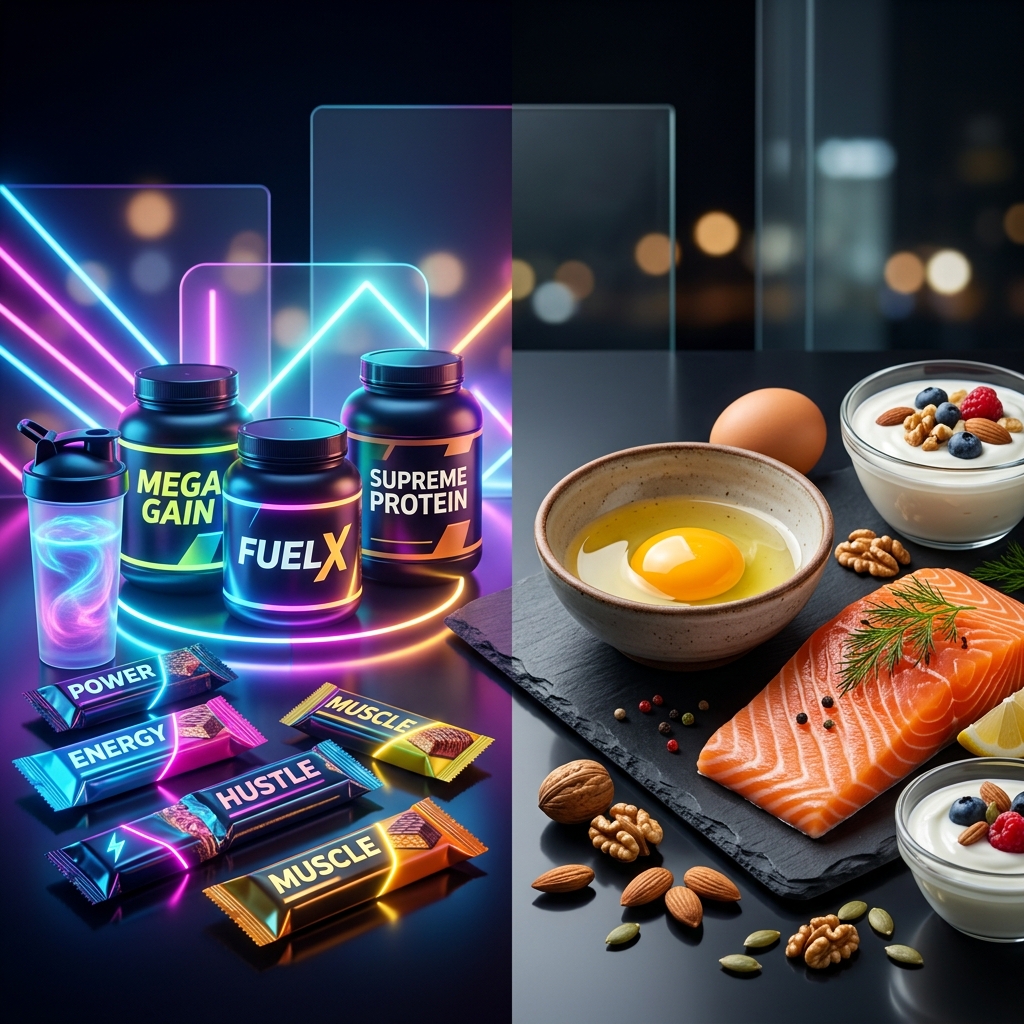
Walk into any grocery store in 2026 and you will see protein everywhere.
Protein bars. Protein cookies. Protein ice cream. Protein cereal. Protein water. Protein chips. Protein puffs. Protein pancakes. Protein pasta.
The category grew nearly 40 percent between 2022 and 2025 (NielsenIQ, 2025). The food industry has never been so eager to give you more of something.
Here is the problem.
Most of these products are not, in any meaningful sense, food.
They are NOVA 4 ultra-processed industrial formulations dressed up with a protein isolate and a marketing claim. The fact that more protein is genuinely good for most adults — and the food industry knows it — does not mean that more of any product that says “protein” on the front is good for you.
That is the protein hustle. Let me explain how it works.
The Real Science
First, the part that’s true. Protein at every meal is one of the most well-supported recommendations in modern nutrition. Especially for women in midlife, athletes, and anyone recovering from illness or injury.
The 2025–2030 USDA Dietary Guidelines for Americans explicitly raised the adult protein target to 1.2 to 1.6 grams per kilogram of body weight per day (USDA & U.S. Department of Health and Human Services, 2025). That’s significantly higher than the old recommendation. It’s also more aligned with what muscle physiology researchers — Stuart Phillips at McMaster University, in particular — have been arguing for over a decade (Phillips et al., 2016).
The science is clear:
- Most adults under-consume protein, especially older adults and women in midlife (Bauer et al., 2013).
- Distributing protein evenly across meals — roughly 25 to 30 grams per meal — is more effective for muscle protein synthesis than back-loading it at dinner (Mamerow et al., 2014).
- Protein quality matters. Complete proteins. Bioavailability. These are real considerations, not marketing claims (Morton et al., 2018).
Hitting the new target requires real attention for most adults. The goal is correct.
The problem is what’s being sold to meet it.
The Trick
When a product brags “20 grams of protein!” on the front of the package, it is making a single, narrow claim. It is not telling you:
- Whether the protein is from a whole-food source (eggs, dairy, meat, legumes) or from an industrial isolate (whey isolate, soy isolate, pea isolate, casein hydrolysate, collagen peptides).
- How many other ingredients are in the product, and whether those ingredients are NOVA 4.
- What sweeteners, gums, emulsifiers, and “natural flavors” the product depends on for texture and palatability.
- Whether the protein is bioavailable enough that your body actually uses it as efficiently as the label number suggests.
The typical “high protein” bar on a 2026 grocery shelf contains some combination of: protein isolate, sucralose or another non-nutritive sweetener, sugar alcohols, soy lecithin, gum acacia, “natural flavors,” palm or palm kernel oil, and a flavor system engineered to mimic candy.
By the NOVA classification, that is ultra-processed.
By the front-of-package claim, it is “high protein.”
Both are true.
That is the trick.
What Real Food Looks Like
Here is what hitting your protein target with NOVA 1 and NOVA 2 foods actually looks like:
- One large egg: about 6 g of protein.
- One cup plain Greek yogurt (5%): 18–20 g.
- One cup cottage cheese: 25 g.
- Four ounces cooked chicken breast: 35 g.
- Four ounces cooked salmon: 25 g.
- One cup cooked lentils: 18 g.
- One ounce nuts: 5–7 g.
- One cup milk: 8 g.
A breakfast of two eggs, a cup of Greek yogurt with berries, and a cup of milk delivers about 35 grams of protein from entirely NOVA 1 sources. Before lunch even starts.
A snack of cottage cheese with cucumber and a sprinkle of nutritional yeast (Gator’s favorite) delivers 25 to 30 grams while being deeply unprocessed.
You do not need a wrapper. You need a refrigerator and the habit of pairing protein with everything you eat.
The Trap
The most common mistake well-intentioned eaters make is this: they hear “protein is important,” they assess their existing diet, they decide they need to eat more, and they reach for the products that are loudest about being high in it.
Those products are mostly engineered. They are mostly ultra-processed. They are mostly the food industry borrowing the credibility of legitimate nutrition science to sell you the same hyperpalatable, shelf-stable, 14-ingredient formulations they have always sold you — just with one extra word on the front of the package.
The fix is not more protein bars.
The fix is structuring meals around real protein sources you already have access to. Eggs. Plain yogurt. Cottage cheese. Beans. Fish. Chicken. Beef. Milk. Nuts. Seeds.
None of these need a marketing campaign. None of them need a 14-ingredient list. They have been doing the job since long before the food industry discovered how to put “20 g protein” on a candy bar.
The Bottom Line
Eat enough protein.
Eat it from real sources.
Distribute it across the day.
That is the whole game.
Anything else marketed at you — anything wrapped, sealed, shelf-stable for 18 months, and built around a protein isolate — is the food industry’s protein hustle. It has nothing to do with your actual protein needs.
Don’t fall for it.
Want to know if a “high-protein” product is real food or marketing in disguise?
Scan it with Rock The New Food Pyramid. The system reads through the front-of-package claims and gives you the actual NOVA score, ingredient breakdown, and real-food alternatives.
Real protein doesn’t need a wrapper.
RockTheNewFoodPyramid.com.
References
Bauer, J., Biolo, G., Cederholm, T., Cesari, M., Cruz-Jentoft, A. J., Morley, J. E., Phillips, S., Sieber, C., Stehle, P., Teta, D., Visvanathan, R., Volpi, E., & Boirie, Y. (2013). Evidence-based recommendations for optimal dietary protein intake in older people: A position paper from the PROT-AGE Study Group. Journal of the American Medical Directors Association, 14(8), 542–559.
Mamerow, M. M., Mettler, J. A., English, K. L., Casperson, S. L., Arentson-Lantz, E., Sheffield-Moore, M., Layman, D. K., & Paddon-Jones, D. (2014). Dietary protein distribution positively influences 24-h muscle protein synthesis in healthy adults. Journal of Nutrition, 144(6), 876–880.
Morton, R. W., Murphy, K. T., McKellar, S. R., Schoenfeld, B. J., Henselmans, M., Helms, E., Aragon, A. A., Devries, M. C., Banfield, L., Krieger, J. W., & Phillips, S. M. (2018). A systematic review, meta-analysis and meta-regression of the effect of protein supplementation on resistance training-induced gains in muscle mass and strength in healthy adults. British Journal of Sports Medicine, 52(6), 376–384.
NielsenIQ. (2025). Category growth: High-protein products in U.S. retail (2022–2025). NielsenIQ Reports.
Phillips, S. M. (2014). A brief review of higher dietary protein diets in weight loss: A focus on athletes. Sports Medicine, 44(Suppl 2), 149–153.
Phillips, S. M., Chevalier, S., & Leidy, H. J. (2016). Protein “requirements” beyond the RDA: Implications for optimizing health. Applied Physiology, Nutrition, and Metabolism, 41(5), 565–572.
U.S. Department of Agriculture & U.S. Department of Health and Human Services. (2025). Dietary guidelines for Americans, 2025–2030. DietaryGuidelines.gov.