
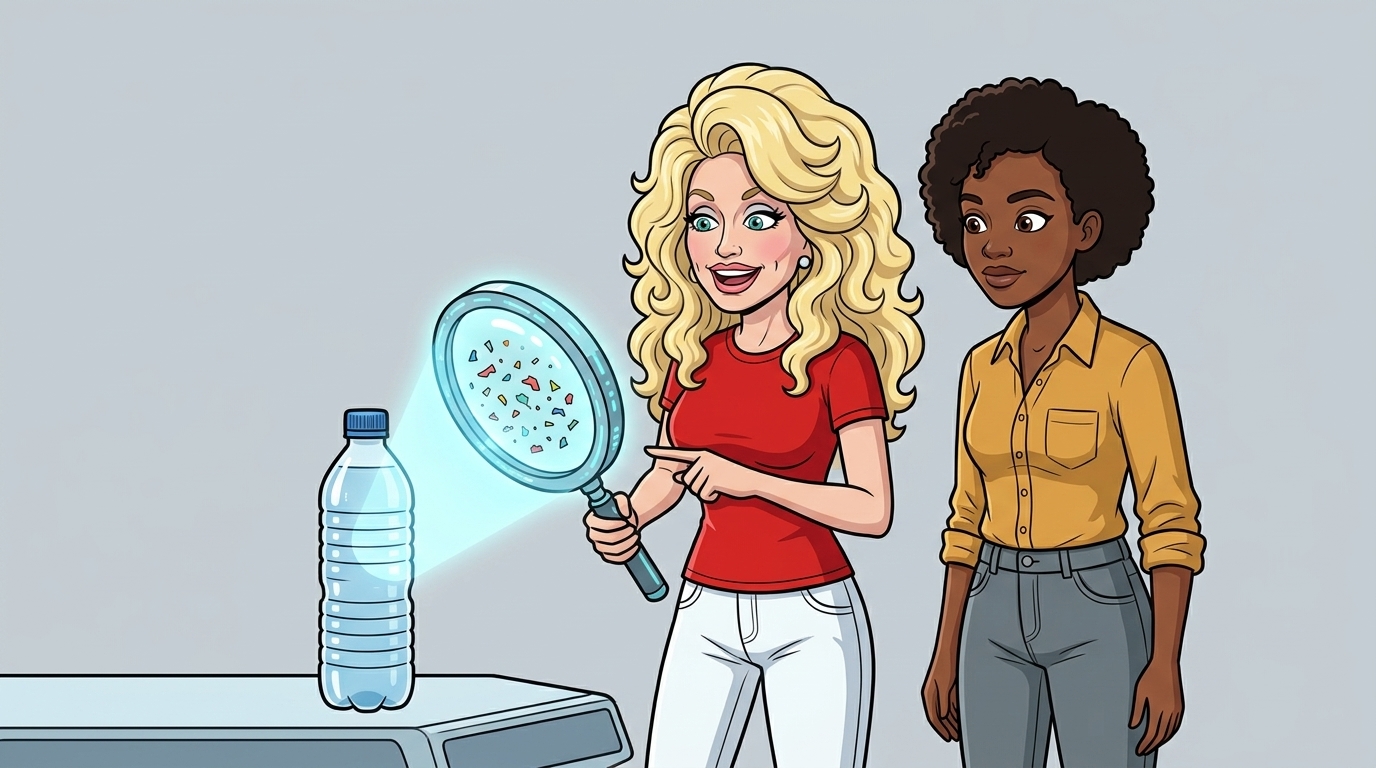
Most of what’s been written about microplastics has fallen into one of two camps.
The first is the alarmists. Plastic in your blood. Plastic in your placenta. Plastic in your unborn child. The end is near. Panic accordingly.
The second is the dismissers. We don’t really know what it does. The science isn’t settled. Don’t worry until we have more data.
Both miss the actual story. Because over the last three years, the peer-reviewed research has gotten substantially clearer. And the practical implications for your kitchen are more concrete than either camp wants to admit.
So let’s actually look at what was published. And then let’s talk about what to do about it.
What the Research Now Shows
Microplastics are plastic particles smaller than five millimeters. Nanoplastics are smaller than one micrometer. They come from the breakdown of larger plastics, from industrial runoff, and increasingly from food packaging itself.
The first study to find microplastics in a human placenta was Ragusa et al. (2021), in Environment International. That finding shocked the researchers themselves. Follow-up work documented microplastic contamination in human breastmilk samples (Ragusa et al., 2022).
And then came the Marfella study.
Marfella et al. (2024), published in the New England Journal of Medicine — which is to medical journals what the Supreme Court is to law — examined arterial plaques removed from patients during carotid surgery. The researchers found microplastic and nanoplastic particles embedded in the plaques. And — this is the part that changed the conversation — patients with microplastic-containing plaques had significantly higher rates of cardiovascular events over the following three years.
Until Marfella, microplastic findings in tissue had been alarming but mechanistically vague. They’re there. But does it matter?
Marfella was the first major study to say: yes. It matters.
Other 2023–2025 work has added contamination findings in human stool (Schwabl et al., 2019), in liver and kidney tissue, and in human brain tissue (Nihart et al., 2025). Estimates of average daily ingestion vary. They consistently land in the thousands of particles per person per day. The largest single source is food and beverages.
That’s the science. That is what we know now that we did not know in 2020.
Where the Plastic Comes From
Now the practical part.
Not all foods deliver microplastics equally. The supply chain matters. Here’s where the plastic actually enters your body:
Plastic packaging contact is the single biggest documented source. Foods stored in plastic — especially with heat (microwaving, hot drinks in plastic, plastic-wrapped food in a sunny car) — consistently test higher.
Bottled water contains 10 to 100 times more microplastic particles than tap water in most studies (Mason et al., 2018). The plastic comes from the bottle.
Tea bags with plastic mesh release millions of microplastic particles per cup when you steep them (Hernandez et al., 2019). Those “silken” or “pyramid” tea bags? Nylon and polyethylene. You’re brewing plastic.
Salt harvested from polluted oceans. Iodized table salt has tested positive for microplastic in multiple studies (Karami et al., 2017).
Seafood — particularly shellfish — accumulates microplastic from polluted waters.
Ultra-processed foods generally show higher contamination than minimally processed equivalents. Long supply chains. Extensive plastic contact during manufacturing. Flexible-film packaging. The same products linked to chronic disease through their formulations are also delivering higher microplastic loads through their packaging.
Notice the pattern. NOVA 4 ultra-processed foods are not just nutritionally compromised. They are packaging-compromised. The harm overlaps.
What You Can Actually Do
You cannot eliminate microplastic exposure. It’s in the air. It’s in the soil. It’s in the rain. We are past that.
You can meaningfully reduce your exposure with a small list of swaps. Here it is:
Storage. Move out of plastic. Glass containers, stainless steel, ceramic. Especially for hot foods, microwaved foods, and acidic foods like tomato sauce, citrus, and vinegar.
Drinking. Filtered tap water in a glass or stainless steel bottle. Not bottled.
Tea. Loose-leaf in a metal infuser. Or paper tea bags clearly labeled as plastic-free. If it’s silky, it’s nylon.
Cooking. Wooden or bamboo cutting boards instead of plastic. Cast iron or stainless steel cookware instead of nonstick (which can shed both microplastics and PFAS — a separate problem we’ll get into another time). Don’t microwave in plastic. “Microwave-safe” is a marketing term, not a chemistry guarantee.
Diet. Lean toward NOVA 1 and NOVA 2 foods. The packaging contact alone makes ultra-processed products a higher-exposure category, regardless of nutrition.
That’s the list. None of it is exotic. None of it is expensive. Most of it is what your grandmother already did.
Why NOVA Helps Here Too
The framework Rock The New Food Pyramid is built around — NOVA, the peer-reviewed processing classification — was designed to track nutritional risk. But it turns out NOVA tracks something else, too: how processed your food’s journey has been. How many plants. How many plastic films. How many supply-chain hops between the field and your fridge.
When you stay in NOVA 1, 2, and 3, you eat less industrial product. Which means less industrial packaging. Which means less of whatever the packaging shed into the food before you bought it.
It’s the same answer for nutrition. It’s the same answer for chemical exposure. It is, at this point, the answer for almost everything.
Worried about what’s in your food beyond nutrition?
Rock The New Food Pyramid’s scanner and Food Analyzer help you stay in NOVA 1, 2, and 3 — which means less ultra-processing, less packaging contact, and less microplastic exposure as part of the bargain.
Start at RockTheNewFoodPyramid.com.
References
Hernandez, L. M., Xu, E. G., Larsson, H. C. E., Tahara, R., Maisuria, V. B., & Tufenkji, N. (2019). Plastic teabags release billions of microparticles and nanoparticles into tea. Environmental Science and Technology, 53(21), 12300–12310.
Karami, A., Golieskardi, A., Choo, C. K., Larat, V., Galloway, T. S., & Salamatinia, B. (2017). The presence of microplastics in commercial salts from different countries. Scientific Reports, 7, 46173.
Ragusa, A., Notarstefano, V., Svelato, A., et al. (2022). Raman microspectroscopy detection and characterisation of microplastics in human breastmilk. Polymers, 14(13), 2700.
Marfella, R., Prattichizzo, F., Sardu, C., Fulgenzi, G., Graciotti, L., Spadoni, T., D’Onofrio, N., Scisciola, L., La Grotta, R., Frigé, C., Pellegrini, V., Municinò, M., Siniscalchi, M., Spinetti, F., Vigliotti, G., Vecchione, C., Carrizzo, A., Accarino, G., Squillante, A., … Paolisso, G. (2024). Microplastics and nanoplastics in atheromas and cardiovascular events. New England Journal of Medicine, 390(10), 900–910.
Mason, S. A., Welch, V. G., & Neratko, J. (2018). Synthetic polymer contamination in bottled water. Frontiers in Chemistry, 6, 407.
Nihart, A. J., Garcia, M. A., El Hayek, E., Liu, R., Olewine, M., Kingston, J. D., Castillo, E. F., Gullapalli, R. R., Howard, T., Bleske, B., Scott, J., Gonzalez-Estrella, J., Gross, J. M., Spilde, M., Adolphi, N. L., Gallego, D. F., Jarrell, H. S., Dvorscak, G., Zuluaga-Ruiz, M. E., … Campen, M. J. (2024). Bioaccumulation of microplastics in decedent human brains. Nature Medicine, 30.
Ragusa, A., Svelato, A., Santacroce, C., Catalano, P., Notarstefano, V., Carnevali, O., Papa, F., Rongioletti, M. C. A., Baiocco, F., Draghi, S., D’Amore, E., Rinaldo, D., Matta, M., & Giorgini, E. (2021). Plasticenta: First evidence of microplastics in human placenta. Environment International, 146, 106274.
Schwabl, P., Köppel, S., Königshofer, P., Bucsics, T., Trauner, M., Reiberger, T., & Liebmann, B. (2019). Detection of various microplastics in human stool: A prospective case series. Annals of Internal Medicine, 171(7), 453–457.