
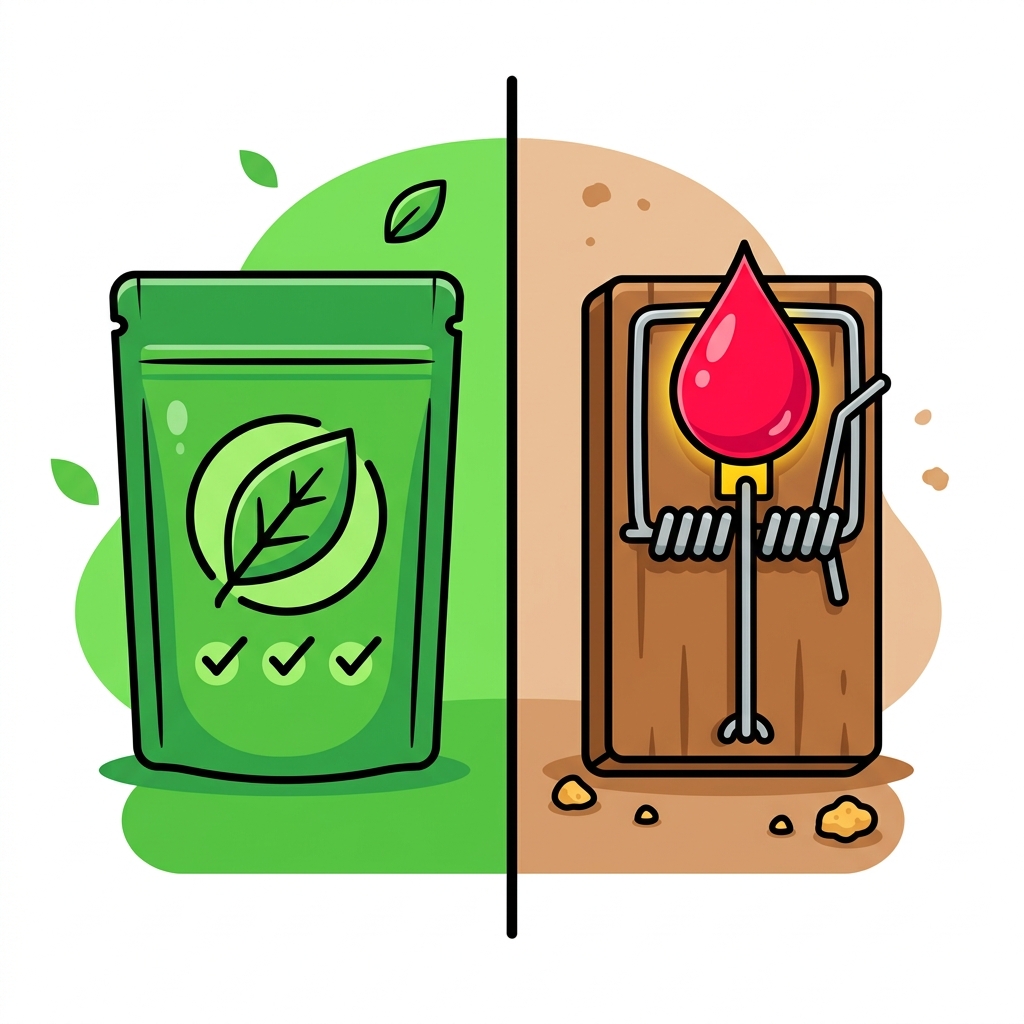
You've seen them everywhere. Packages that look like they're practically begging you to trust them.
"No artificial colors!" "Made with real ingredients!" "Clean label!"
They look good. They sound good. You feel better about tossing them in the cart.
But here's the thing — are they actually better?
The short answer: sometimes.
The long answer: it depends on whether you're reading the label or scanning the product.
Because here's what the food industry doesn't want you to know: "clean label" isn't a regulated term. It's a marketing phrase. And marketing, as we've discussed, is the art of making you feel good about what you're eating.
The Clean Label Trap
Here's the problem: "clean label" is basically the Wild West of food marketing. A company can slap "clean" on a product without meeting any specific standard. Zero. None. Nada.
And they can swap one questionable ingredient for another without changing the overall processing level whatsoever.
Let me give you some examples that'll make you go, "Wait, WHAT?"
- A product might drop artificial red dye and replace it with beet juice concentrate — but still be ultra-processed. Still packed with stuff your body doesn't recognize. Still making your cells do a double-take.
- A product might remove high-fructose corn syrup and replace it with cane sugar — but still be loaded with emulsifiers and preservatives. The sugar is different. The rest of the chemistry is the same.
The label looks cleaner. But the product isn't necessarily healthier.
It's like putting lipstick on a pig. And I love pigs — they're smart, they're cute, they're loyal. But lipstick doesn't make a pig a different animal.
What's Actually Changing in 2026
Now, here's the good news — because there IS good news.
Some changes are real. And they're happening right now.
Food dyes are getting the boot. Red 3, Yellow 5, and Yellow 6 are being phased out by some major brands. Why? Health concerns and state-level bans. States like California and West Virginia are leading the charge, and the rest of the country is watching.
This is actually a win. These dyes have been linked to hyperactivity in kids and other health concerns. And the fact that companies are responding means consumer pressure works.
Emulsifiers are under scrutiny. Carrageenan, polysorbate-80, and similar additives are facing more scrutiny than ever — research has linked some emulsifiers to gut-barrier disruption. Some companies are switching to alternatives like guar gum.
Now, is guar gum perfect? No. But it's a step in the right direction. Progress isn't about perfection — it's about movement.
Preservatives are getting natural. Synthetic preservatives are being replaced with natural options like vitamin E extract and rosemary extract. Rosemary! In your food! As a preservative! It's almost poetic.
But here's the catch — and I'm going to be straight with you.
Not all replacements are better. Some natural alternatives have their own issues. And some "natural" additives are just as processed as the synthetic versions they're replacing.
It's like swapping one flavor of fake for another. The packaging changed. The game didn't.
How to Tell the Difference
This is where Gator Grade shines.
When you scan a product, you're not just seeing the label claims — you're getting a score that factors in the actual ingredients, processing level, and additive risk.
If a product reformulates for real, the score goes up. If it's just marketing, the score stays the same.
Simple as that.
No guessing. No interpreting. No trying to figure out whether "natural flavors" means natural or means "we found a loophole."
Just a real score. Based on real ingredients. For real families.
The Bottom Line
Here's what I want you to remember: you deserve clarity, not confusion.
The food industry is catching up. Companies are reformulating. Labels are changing. Progress is happening.
But progress doesn't mean everything is perfect. It means the ground is shifting — and you're the one who decides whether to follow it or lead it.
Don't trust the label. Scan the product. Check the score. Make your decision based on what's actually in the food — not what the package claims.
You're smarter than a marketing department. And your family deserves the real deal. 🐊
Download Rock The New Food Pyramid. Scan your groceries. Know what you're feeding your family.
References
U.S. Food and Drug Administration. Color Additives in Foods. FDA.gov.
Center for Science in the Public Interest. Clean labels: What they do and don't mean. cspi.org.
Chassaing, B., Koren, O., Goodrich, J. K., et al. (2015). Dietary emulsifiers impact the mouse gut microbiota promoting colitis and metabolic syndrome. Nature, 519(7541), 92-96.
Rock The New Food Pyramid — Scan. Know. Choose Better.