Here's something the food industry counts on: your ignorance. They rely on the fact that most people will never flip the package over, never research the ingredient list, and never ask the uncomfortable question: what exactly is this stuff I'm putting in my body?
But sometimes, enough people wake up — and when they do, even the most powerful brands on earth are forced to back down. The following two cases are proof that consumer outrage works. They are also a reminder of what these corporations were willing to feed you in the first place.
Buckle up. It's gross.
🐛 Case #1: Starbucks Was Coloring Your Drinks with Crushed Bugs
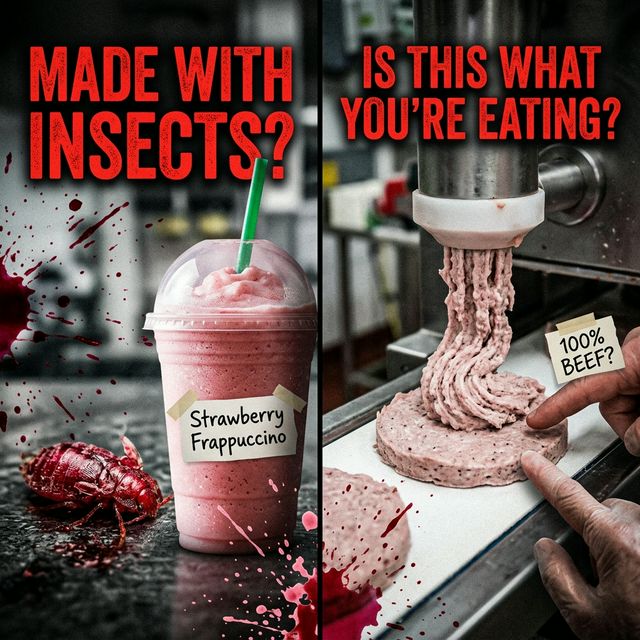
For years, millions of people ordered the Starbucks Strawberry Frappuccino, Strawberry Smoothie, and other pink-hued beverages thinking they were getting something fruity and refreshing. What they were actually drinking was carmine — a red dye made by grinding up the dried, desiccated bodies of Dactylopius coccus, a small parasitic insect that lives on cactus plants.
Yes. Bugs. In your Frappuccino.
Carmine — also listed on labels as cochineal extract, E120, or simply "natural color" — requires harvesting and crushing approximately 70,000 insects to produce just one pound of dye. The resulting pigment produces a vivid, stable red-pink color and has been used in food for centuries. Which is precisely why the food industry loves it: it's cheap, it's stable, and the FDA allows manufacturers to hide it under the vague umbrella of "natural color."
The Moment It All Fell Apart
In early 2012, a vegan food blogger named Daelyn Fortney noticed something odd on the Starbucks website when she was trying to verify that a drink was vegan: the Strawberry Frappuccino contained cochineal extract. She posted about it online. The story exploded.
Within weeks, a Change.org petition demanding Starbucks remove insect-based dye from its products accumulated over 6,500 signatures in 24 hours. Major media outlets picked up the story. Social media erupted with a mixture of horror, outrage, and dark humor. Vegetarians, vegans, and people with kosher or halal dietary restrictions were furious — not just because they had unknowingly consumed insect products, but because Starbucks had been hiding it behind that meaningless phrase: "natural color."
Starbucks Blinked
By April 2012 — just three months after the story broke — Starbucks publicly announced it would reformulate its strawberry flavoring to use lycopene, a pigment derived from tomatoes, rather than carmine. They apologized. They updated their ingredient disclosures.
The lesson? They knew what they were using. They just didn't think you'd find out. The moment you did — the moment enough of you made enough noise — they changed it in three months flat. A reformulation that supposedly "takes time" happened at lightning speed the moment it became a PR catastrophe.
And for the record: carmine and cochineal extract are still legally used in hundreds of other food and cosmetic products in the United States to this day. It is still hiding in your yogurt, cherry-flavored candy, some fruit juices, and even certain cosmetics under the label of "natural color." It is not banned. Starbucks changed. Most of the industry didn't.
🤢 Case #2: McDonald's Was Stuffing Their Beef with Ammonia-Washed Slime
If the Starbucks story made you gag, this one might make you put down whatever you're eating.
For years — quietly, legally, and with full FDA approval — McDonald's was using a product that even the USDA's own microbiologists privately referred to as "pink slime."
Officially, the product is called Lean Finely Textured Beef (LFTB). Here's how it's made: conventional beef processing generates a large amount of fatty beef trimmings — the scraps and connective tissue left over after the prime cuts have been removed. Normally, this material would be considered too fatty, too risky for pathogens, and too low-quality to go directly into ground beef.
The solution the industry found? Run the fatty trimmings through a centrifuge at high speed to separate the fat from the remaining beef bits. Then — because the end product is at high risk of contamination with E. coli and Salmonella — spray the entire resulting mass with ammonium hydroxide gas.
That's right. They treated your beef with an industrial chemical you'd find in a cleaning supply closet. Then they compressed the ammonia-treated paste into blocks, flash-froze it, and sent it to fast food chains to be incorporated into ground beef.
The Man Who Blew the Whistle
The term "pink slime" didn't come from a food blogger or an activist. It came from a USDA microbiologist named Gerald Zirnstein, who saw the product being used in 2002 and wrote in an internal email that he did not "consider the stuff to be ground beef" and that "it's pink slime." His colleagues agreed. The complaint was ignored. LFTB continued to be used — unlabeled — in beef products consumed by millions of Americans, including in the National School Lunch Program.
The story stayed buried for nearly a decade until celebrity chef Jamie Oliver dramatically demonstrated the process on his television show Jamie Oliver's Food Revolution in 2011. Oliver poured the greasy trimmings into a washing machine-style contraption, spun out the fat, and then held up the processed result — grey-pink, paste-like beef bits — before demonstrating how it was then treated with ammonia. The audience was visibly nauseated.
The clip went massively viral. News outlets ran it nationally. Parents were horrified that this material was being served to their children in school cafeterias. An ABC News investigation brought the story to a massive mainstream audience in early 2012, with ABC specifically reporting that approximately 70% of ground beef sold in American supermarkets contained LFTB.
The Industry Collapsed Overnight
The consumer backlash was immediate and devastating. Within weeks:
- McDonald's, Burger King, and Taco Bell all publicly announced they had stopped using LFTB in their products.
- Major supermarket chains including Kroger, Safeway, Food Lion, and Costco announced they would no longer sell ground beef containing LFTB.
- The USDA offered schools the option to order beef without LFTB — within days, most states chose the option without it.
- Beef Products Inc., the largest LFTB manufacturer, was forced to close three of its four plants and lay off hundreds of workers due to plummeting demand.
A product that once occupied 70% of the American ground beef supply was effectively removed from the mainstream market by consumer outrage in under two months. No law was passed. No regulator acted. You — the consumer — did it.
What This Tells Us
Both stories share a chilling common thread: these practices were not accidents. They were not mistakes. They were deliberate business decisions made by companies that calculated the profit margin of cheap, disgusting ingredients against the risk of you ever finding out. Both times, the calculation was wrong.
Both carmine and LFTB were — and in many cases still are — completely legal under US food law. The FDA approved them. The USDA approved them. The regulatory system designed to protect you signed off on feeding you crushed insects and ammonia-washed meat scraps without even requiring clear labeling.
The only thing that changed was you finding out about it.
🔍 Find Out What's In YOUR Food Right Now
The uncomfortable truth? If these two massive global brands were quietly using bug dye and ammonia-treated slime for years without telling you, what do you think is still hiding in your food right now?
You don't have to wait for a viral news story or a celebrity chef to tell you. Rock the New Food Pyramid lets you search any food product and instantly see every ingredient — including the ones buried in fine print under cover names like "natural color," "natural flavors," and "lean finely textured beef." Our AI-powered analysis will flag what's concerning, what's banned in other countries, and where it falls on the NOVA scale of processing.
📢 Make Your Voice Heard
Consumer outrage changed Starbucks and McDonald's without a single law being passed. Imagine what happens when that outrage is organized and directed at the government agencies and legislators who have the power to change the rules permanently.
The FDA, the USDA, your state agriculture departments, and your elected representatives do listen — especially when enough constituents make enough noise. We've made it easy. Our Take Action page gives you direct links to contact the FDA, the USDA, and your local representatives, along with template messages you can send in minutes.
You made Starbucks ditch the bugs. You made McDonald's ditch the slime. Don't stop there.
#RockTheNewFoodPyramid
References & Citations
- University of São Paulo (USP) Center for Epidemiological Studies in Health and Nutrition. The NOVA Food Classification System.
- National Academies of Sciences, Engineering, and Medicine (NASEM). Toxicology and Safety Assessments of Food Additives.