
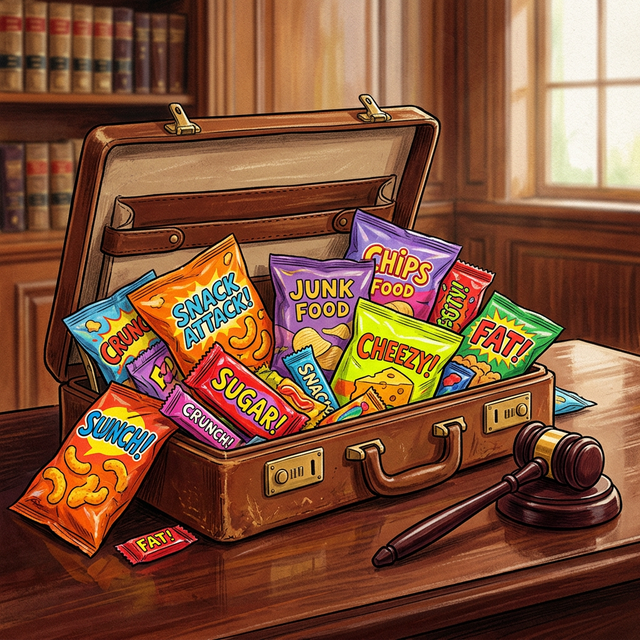
For decades, when Americans got sick from the food they ate, the blame was placed entirely on the consumer. "You just need more willpower," the experts said. "Eat less, move more."
But the legal landscape is shifting rapidly. Borrowing the exact playbook used to bring down Big Tobacco in the 1990s, a massive wave of litigation is currently forming against the titans of the processed food industry.
The Allegations: Engineered Addiction
Recent lawsuits—including a landmark case filed by a plaintiff in Pennsylvania and a massive lawsuit initiated by the city of San Francisco—are taking aim at companies like Kraft Heinz, Mondelez, Post Holdings, and Kellogg's.
The core allegation is not just that these companies sell unhealthy food. The lawsuits allege that these corporations intentionally engineered their products to be highly addictive, bypassing our natural biological satiety signals, and then aggressively marketed these dangerous products specifically to children.
The Big Tobacco Parallel
In the 1990s, the tobacco industry claimed they were just selling a legal product that people enjoyed by choice. They lost when whistleblowers and internal documents proved that executives knew nicotine was addictive and deliberately manipulated its levels to keep users hooked.
Lawyers pursuing "Big Food" are looking for the exact same smoking gun. They point to the meticulous science of the "Bliss Point"—the exact, laboratory-calculated ratio of sugar, salt, and fat designed to maximize craving and override the brain's "I'm full" signal. They argue that feeding a child an ultra-processed snack engineered in a lab is fundamentally different from feeding them an apple.
The Health Toll
These lawsuits link the aggressive marketing of Ultra-Processed Foods (UPFs) directly to the explosion of childhood diseases that were virtually nonexistent a century ago:
- Pediatric Type 2 Diabetes
- Non-Alcoholic Fatty Liver Disease (NAFLD) in children
- Early-onset metabolic syndrome
With the "Make America Healthy Again" (MAHA) movement providing political cover, Reuters recently named UPF litigation as a "mass tort to watch." Even if early lawsuits face hurdles in proving direct causation between a single product and a specific illness, the discovery phase—where internal corporate emails and research documents are forced into the public eye—could be devastating to the industry's public image.
What This Means for You
The era of trusting the front-of-package marketing is over. As these lawsuits progress, we are going to learn exactly how much science went into keeping us addicted to the center aisles of the grocery store.
You don't have to wait for a court verdict to protect yourself. Use Rock the New Food Pyramid to scan your pantry and cut out the engineered, ultra-processed products the industry wants you to keep buying.
References & Citations
- University of São Paulo (USP) Center for Epidemiological Studies in Health and Nutrition. The NOVA Food Classification System.
- National Academies of Sciences, Engineering, and Medicine (NASEM). Toxicology and Safety Assessments of Food Additives.