
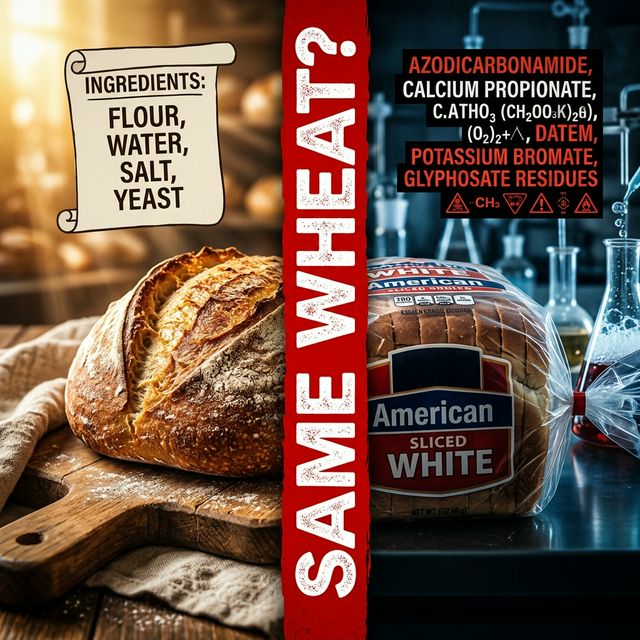
You've probably heard some version of this story: an American who has struggled with bloating, brain fog, and digestive misery for years goes on a trip to Italy or France. They figure they'll just tough it out and avoid bread. Then, on day two, they give in — pasta for dinner, a baguette with breakfast — and wait for the suffering to begin.
It doesn't come.
They eat bread every single day for two weeks and feel completely fine. They come home baffled. And then they eat a sandwich from their American grocery store and spend the rest of the afternoon on the couch.
This is not an anecdotal anomaly. It's a pattern so common that researchers have a name for it, and a growing body of peer-reviewed science is now asking the question millions of "gluten-sensitive" Americans are afraid to ask: What if it was never actually the gluten?
This article is educational, not medical advice. If you have been diagnosed with celiac disease — a serious autoimmune condition — you must follow your doctor's guidance and maintain a strict gluten-free diet. The following discussion applies to the growing population labeled with non-celiac gluten sensitivity (NCGS), which is a distinct and far less understood condition.
First, Let's Separate Two Very Different Things
Celiac disease is a well-defined autoimmune disorder. When people with celiac eat gluten — the protein found in wheat, barley, and rye — their immune system attacks the lining of the small intestine. The damage is measurable. The science is settled. Gluten is the cause. There is no debate.
Non-celiac gluten sensitivity (NCGS) is something different entirely. People with NCGS test negative for celiac disease and negative for wheat allergy, but report real, consistent symptoms after eating wheat — bloating, fatigue, headaches, brain fog, joint pain, skin issues. For years, the medical establishment dismissed these symptoms as psychosomatic. Newer research confirms they are biological and real.
But here's where it gets interesting: researchers are increasingly questioning whether gluten is the actual culprit for NCGS. The scientific community has begun quietly shifting the terminology from "non-celiac gluten sensitivity" to "non-celiac wheat sensitivity" (NCWS) — because the evidence points to other components of wheat products, not gluten itself.
And when you look at what American bread actually contains compared to European bread, a much more disturbing picture emerges.
The Suspects: What's Actually in Your American Bread
Pick up a loaf of major commercial sandwich bread from an American grocery store and flip it over. Here's what you'll likely find beyond the flour, water, yeast, and salt:
🧪 1. Azodicarbonamide (ADA) — The Yoga Mat Chemical
You may remember this one from the Subway scandal a few years ago. Azodicarbonamide is a chemical additive used as a dough conditioner and bleaching agent. It dramatically speeds up the dough-making process and produces a softer, higher-rising loaf.
It is also used industrially to make yoga mats, shoe soles, and other foamed plastics.
ADA is banned in the European Union, Australia, and the United Kingdom as a food additive. The EU scientific panel noted that its decomposition produces a compound called semicarbazide, which animal studies have shown carries carcinogenic potential. In the US, it's still perfectly legal and continues to appear in dozens of major commercial bread brands, fast food buns, and bagels.
Some individuals with self-reported "gluten sensitivity" have noted that their symptoms disappear when they switch to breads that don't contain ADA. The connection hasn't been definitively proven in large clinical trials — but it hasn't been disproven either.
🌾 2. Glyphosate — The Herbicide That Ends Up in Your Flour
Here is a practice that surprises most Americans: in the US, many commercial wheat crops are sprayed directly with glyphosate (Roundup) just before harvest. This isn't for weed control — the crop is already mature. It's used as a desiccant: the herbicide kills the wheat plant, drying it out uniformly so it can be harvested faster and more efficiently.
The result? Glyphosate residues are found in the harvested wheat — and consequently in the flour, and in the bread you eat.
This practice is banned or heavily restricted in most of the European Union. European farmers cannot use glyphosate as a pre-harvest desiccant on wheat crops.
Why does this matter for gut health? Glyphosate's herbicidal mechanism works by disrupting what's called the shikimate pathway — a biochemical process used by plants and bacteria. Human cells don't use this pathway. But the 100 trillion bacteria in your gut do.
Multiple studies, including research published in peer-reviewed journals, have found that glyphosate disrupts the composition of the gut microbiome, specifically reducing populations of beneficial bacteria like Lactobacillus and Bifidobacterium — the same bacteria that help digest gluten and maintain a healthy intestinal lining. A disrupted gut microbiome produces symptoms that are remarkably similar to what people call "gluten sensitivity": bloating, digestive upset, inflammation, and brain fog.
A 2013 study published in the journal Interdisciplinary Toxicology went further, proposing that glyphosate could be a significant contributing factor to the dramatic rise in celiac disease and gluten intolerance over the last 30 years. The paper noted that the rate of increase in both celiac disease and glyphosate usage on wheat crops in the US track almost perfectly together from the 1990s onward. The authors were careful to note this was a correlation, not proof of causation — but it is a correlation that is very difficult to ignore.
🧫 3. DATEM (Diacetyl Tartaric Acid Ester of Mono- and Diglycerides)
DATEM is an emulsifier added to breads to strengthen gluten strands, improve dough stability, and extend shelf life. It's in hundreds of commercial bread products.
Research published in the journal Gut has linked certain food emulsifiers — the class of additives DATEM belongs to — to disruption of the intestinal mucus layer and an increase in intestinal permeability. You may have heard the term "leaky gut." When the intestinal lining is compromised, partially digested food particles and bacterial components can pass into the bloodstream, triggering systemic inflammation. The symptoms? They look a lot like what people describe as gluten sensitivity.
🔬 4. Calcium Propionate — The Mold Inhibitor
Calcium propionate is the preservative that lets American sandwich bread stay "fresh" on a shelf for two weeks without growing mold. European artisan breads, which don't use it, typically go stale or moldy within 2-3 days — which is why you buy them fresh from a bakery.
Research into calcium propionate's effects on gut bacteria is still evolving, but animal studies have found it can interfere with nutrient absorption and alter gut microbiome composition. One study published in the journal PLOS ONE found that calcium propionate increased levels of certain stress-related hormones. It's generally regarded as safe by the FDA, but "safe" in regulatory terms means it doesn't cause acute harm at the doses consumed — not that it has no effect on gut biology.
⚗️ 5. Potassium Bromate — The Banned Carcinogen Still in Your Buns
We've covered this one before in our "5 Ingredients Banned in Europe" article, but it bears repeating in this context: potassium bromate is added to flour and dough in the US to strengthen structure and improve rise. It is classified as a Group 2B possible human carcinogen by the International Agency for Research on Cancer. It is banned in the EU, UK, Canada, Brazil, China, India, Nigeria, and South Korea. It is still legal in most of the United States.
So What Are Scientists Actually Saying?
The research community has identified at least two components of wheat that are likely more responsible for NCGS symptoms than gluten itself:
- Fructans (a type of FODMAP): A double-blind, placebo-controlled study published in the peer-reviewed journal Gastroenterology found that when researchers isolated gluten and fructans and fed them separately to self-identified gluten-sensitive patients, fructans — not gluten — triggered significantly higher symptom scores. Fructans are fermentable carbohydrates naturally present in wheat that survive digestion and are fermented by gut bacteria, causing gas, bloating, and discomfort. They are dramatically reduced in traditional long-fermented sourdough bread.
- Amylase-Trypsin Inhibitors (ATIs): These are proteins naturally present in wheat that activate the innate immune system and can drive inflammatory responses in the gut. Research published in the journal Gastroenterology has identified ATIs as potential major triggers for NCWS in people who don't have celiac disease. Like FODMAPs, ATIs are reduced by traditional long fermentation methods.
The European Bread Connection Explained
When you piece all of this together, the "I can eat bread in Europe but not in America" phenomenon starts to make a lot of scientific sense:
- European bread doesn't contain ADA, potassium bromate, or many of the other dough additives common in US commercial baking.
- European wheat is typically not pre-harvest desiccated with glyphosate, leaving far lower residues in the flour.
- European artisan bread is commonly made using traditional slower fermentation methods — sometimes 12 to 24+ hours — which significantly reduces FODMAPs, ATIs, and partially breaks down gluten itself, making it easier for many people to digest.
- European supermarket bread, while more processed than artisan, still faces stricter additive regulations than its American counterpart.
The result is a product that shares the name "bread" with American commercial bread but is, chemically and microbiologically, quite a different thing.
The Question Worth Asking
If you identify as gluten-sensitive and have never tried sourdough bread made through genuine long fermentation — with nothing but flour, water, salt, and a starter culture — it may be worth exploring (with your healthcare provider's guidance). Many people who struggle enormously with commercial bread report tolerating real sourdough significantly better.
Similarly, if you've ever bought bread at a farmers market or from an artisan bakery that uses no additives — and felt fine — versus a supermarket loaf that knocked you flat, that difference is worth paying attention to.
We're not drawing conclusions for you. The science is still evolving. What we are saying is that the ingredient list on your bread matters enormously — and that the food industry's use of chemical shortcuts in the name of cheap, shelf-stable, perfectly-textured mass-produced bread may be creating a population of people who believe they cannot eat one of civilization's oldest foods.
🔍 Check What's In Your Bread Right Now
Curious what's actually in the bread you're currently buying? Rock the New Food Pyramid lets you search any food product and immediately see every ingredient, flagging the ones that are concerning, banned internationally, or classified as ultra-processed additives.
You might also want to check out our Dirty 25 ingredient lookup tool — azodicarbonamide and potassium bromate are both on the list.
#RockTheNewFoodPyramid
References & Citations
- University of São Paulo (USP) Center for Epidemiological Studies in Health and Nutrition. The NOVA Food Classification System.
- National Academies of Sciences, Engineering, and Medicine (NASEM). Toxicology and Safety Assessments of Food Additives.